
How Do Marketers Use Data to Identify Goals? 8 Tips & Tricks
19/02/2026
Sales Funnel Optimization: How Data Turns Leaks into Conversions
31/03/2026
B2B data enrichment is one of the most overlooked growth levers in sales today. While teams obsess over messaging, tools, and outreach volume, the real issue often sits quietly in the background: poor data quality.
If your CRM is outdated, incomplete, or inaccurate, your sales team is working with a disadvantage from the start. And no amount of cold emails or follow-ups will fix that.
The difference between average and high-performing sales teams usually comes down to one thing. Better data.
What B2B data enrichment actually means in practice
B2B data enrichment is the process of improving your existing data so it becomes accurate, complete, and actionable.
This is not about buying bigger lists. It is about making your current data usable.
In practice, B2B data enrichment involves:
- Adding missing contact and company information
- Updating job titles and roles
- Validating emails and phone numbers
- Enhancing records with firmographic and technographic data
- Supporting ongoing data cleansing to remove outdated or duplicate entries
The key here is continuity. Data is constantly changing, so enrichment needs to be continuous.
According to Salesforce, sales teams lose significant productivity due to poor CRM data quality. Reps spend time fixing data instead of closing deals. That is a direct revenue problem, not an operational one.
The real problem: data decay
Most teams assume their CRM is reliable.
It is not.
Data starts decaying the moment it enters your system. People switch roles, companies grow or shut down, and contact details become invalid.
Within months, a large percentage of your CRM data becomes outdated.
This leads to emails bouncing or going unanswered, reps targeting the wrong decision-makers, duplicate accounts, and messy pipelines.
Later, this becomes an even bigger issue, as it develops into misleading reporting and forecasts.
Gartner estimates that bad data costs companies an average of $12.9 million per year. That is not just a big enterprise problem. It affects any sales team relying on inaccurate data.
Data enrichment solves this by keeping your data fresh and usable.
Why crm enrichment is where the real value happens
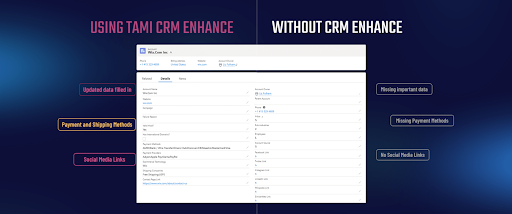
CRM enrichment is the operational layer of data enrichment, as it ensures your CRM is not static. Instead, it becomes a living system that updates continuously.
When crm enrichment is done right, your CRM:
- Updates contact information automatically
- Fills in missing data fields
- Flags outdated or inactive leads
- Maintains consistent, structured records
This changes how sales teams operate.
Instead of spending hours researching leads, reps can focus on conversations that actually move deals forward.
TAMI approaches crm enrichment by continuously updating CRM records with real-time insights, including job changes, company updates, and missing contact data.
That means your team is always working with current information, not outdated snapshots.
Verified contact data is the difference between activity and results
You can have the best targeting and messaging in the world. If your contact data is wrong, none of it matters.
This is where verified contact data becomes critical.
Verified contact data ensures emails reach real inboxes, phone numbers connect to the right people, and outreach performance reflects your actual strategy.
HubSpot highlights that email deliverability is one of the biggest drivers of campaign success. High bounce rates damage your sender's reputation and reduce future reach.
That is why validation matters.
TAMI validates email addresses directly to the inbox and maintains a bounce rate below 5%, which significantly improves outreach performance.
This is not a small improvement. It directly impacts pipeline generation.
Why data cleansing is the foundation of B2B data enrichment
Before you enrich data, you need to clean it.
Data cleansing removes duplicates, corrects inconsistencies, and eliminates irrelevant records. Without it, your CRM becomes cluttered and unreliable.
This is where many teams fail.
They invest in enrichment tools but skip proper data cleansing. The result is more data, but not better data.
Effective B2B data enrichment always includes:
- Deduplication of records
- Removal of inactive accounts
- Standardization of data formats
- Ongoing monitoring of data quality
TAMI, for example, flags bad leads and inactive accounts while continuously updating CRM records to maintain data quality.
This keeps your pipeline clean and actionable.
What actually improves when you implement data enrichment
The impact of B2B data enrichment is immediate and measurable.
First, targeting becomes sharper. You are no longer guessing which accounts fit your ICP. You have real data to guide your decisions.
Second, outreach performance improves. Verified contact data reduces bounce rates and increases response rates.
Third, sales cycles become shorter. Reps spend less time researching and more time engaging with qualified prospects.
Fourth, your pipeline becomes more accurate. With consistent data cleansing, you eliminate duplicates and outdated opportunities.
One example from TAMI showed a 10X improvement in inbound lead conversion compared to other data providers. That kind of result highlights how much data quality influences performance.
How modern sales teams approach B2B data enrichment
The traditional approach to data management does not work anymore.
Exporting lists, cleaning them manually, and re-uploading them is slow and inefficient.
Modern teams treat data enrichment as an ongoing system.
They rely on real-time crm enrichment, continuous validation of contact data, automated data cleansing processes, and alerts when contacts change roles or companies.
This approach removes manual work and ensures data accuracy at scale.
TAMI fits into this model by providing real-time updates and enrichment directly inside the CRM, allowing teams to maintain high-quality data without constant intervention.
This is how sales teams scale without increasing operational overhead.
Why B2B data enrichment creates a competitive advantage
Most companies still rely on outdated or incomplete data.
That creates an opportunity.
If your team has better data, you can reach decision-makers earlier, personalize outreach more effectively, avoid wasting time on low-quality leads, and move faster than your competitors do.
Over time, this compounds into a significant advantage.
B2B data enrichment improves every part of your sales process. It is not just a backend fix. It is a growth strategy.
Final thoughts
Sales teams often try to fix performance by increasing activity. But if your data is wrong, more activity just means more wasted effort.
B2B data enrichment fixes the problem at its source.
When CRM enrichment is continuous, data cleansing is consistent, and your verified contact data is accurate, everything improves. Better data leads to better results. It is that simple.
If you’re serious about improving your sales results, start with your data. Create your free TAMI account today and see how better data turns into better deals.