

Most CRM data cleaning solutions promise cleaner data, better targeting, and higher conversions. And yet, here we are.
We are constantly dealing with bloated CRMs, outdated contacts, bounce rates creeping up, and sales teams quietly losing trust in that same data.
So what’s going wrong?
The issue isn’t that companies aren’t investing in data cleansing tools. It’s that most solutions don’t go far enough. They clean once, maybe enrich a few fields, and call it a day. Meanwhile, your data starts decaying again almost immediately.
This guide cuts through the noise. We’ll break down the CRM data cleaning solutions that actually work in 2026, compare them side by side, and explain why most fail in real-world use.
CRM Data Cleaning Solutions Compared
Before we get into each solution, here are the top 6 CRM data cleaning solutions actually worth your time.
|
Tool |
Core Strength |
Best For |
Pros |
Cons |
Verdict |
|
TAMI |
Real-time enrichment + intent signals |
B2B teams scaling outbound & targeting |
Continuous data refresh, verified contacts, deep firmographic + technographic insights, low bounce rates |
Requires strategy alignment to fully leverage |
Best overall for ongoing CRM health and revenue impact |
|
ZoomInfo |
Large contact database |
Enterprise prospecting |
Massive dataset, strong enrichment features |
Expensive, data can age quickly, limited real-time updates |
Good coverage, weaker on freshness |
|
Cognism |
Compliance-focused data |
GDPR-heavy regions |
Strong compliance, solid European coverage |
Data accuracy varies, less depth in insights |
Reliable but not always actionable |
|
Clearbit |
API-based enrichment |
SaaS and product-led growth |
Easy integrations, fast enrichment |
Limited depth, relies heavily on static datasets |
Good add-on, not a full solution |
|
Apollo |
Sales engagement + data |
SMB outbound teams |
Affordable, all-in-one tool |
Data accuracy inconsistent, limited enrichment depth |
Good starter tool, not scalable long-term |
|
Lusha |
Contact data lookup |
Quick prospecting |
Simple to use, fast results |
Shallow data, no continuous cleaning |
Useful for quick checks, not CRM hygiene |
First Things First: Why Most CRM Data Cleaning Solutions Fail
Let’s be blunt. Most CRM data cleaning solutions fail because they treat data like a one-time problem.
It’s not.
B2B data decays fast. According to multiple industry estimates, around 30% of CRM data becomes outdated every year. People change jobs, companies pivot, emails go inactive, and entire segments become irrelevant.
Yet many tools still operate like this:
- Run a cleanup once
- Enrich a few missing fields
- Export results back into the CRM
- Move on
That’s not cleaning. That’s temporary damage control.
The Real Problems Teams Face
In 2026, teams still have to deal with issues that should’ve been completely eradicated with the use of premium data intelligence tools:
- Data decay never stops - Even if your CRM is clean today, it won’t be next quarter. Static solutions can’t keep up.
- Incomplete enrichment - Adding a job title or company size doesn’t help much if you still don’t know what the company actually does, what tech they use, or whether they’re even relevant
- No validation layer - A “clean” database that still produces bounced emails isn’t clean. It’s just misleading.
- No connection to targeting strategy - Cleaning data without improving targeting is like organizing a messy desk without throwing anything away. It looks better, but nothing really changes.
How Each Solution Actually Performs
Let’s go beyond the comparison table and look at how these tools perform in real scenarios.
1. TAMI
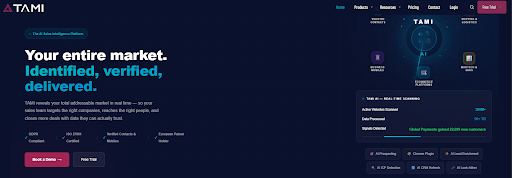
TAMI AI stands out because it doesn’t separate data cleaning from targeting.
It continuously enriches, verifies, and updates CRM data while also adding actionable insights like competitor relationships and technology usage.
That combination matters. In one case, a martech company using TAMI achieved significantly higher email conversion rates compared to other providers, driven by better data accuracy and targeting.
Pros:
- Real-time data cleaning and continuous CRM updates
- Verified contact data with <5% bounce rate
- Deep enrichment, including technographic and market insights
- Built-in intent signals for smarter targeting
- Automatically flags outdated or inactive leads
Cons:
- Requires alignment with sales/marketing strategy to unlock full value
- More advanced than basic tools, so setup may take initial planning
Verdict: If your goal is not just clean data but better pipeline performance, this is the strongest option.
2. ZoomInfo
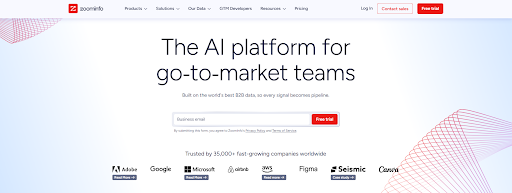
ZoomInfo offers one of the largest B2B databases on the market.
The upside is scale. The downside is freshness.
Without real-time updates, data can become outdated quickly, especially in fast-moving industries. It’s a strong data source, but it often needs additional validation and cleaning layers.
Pros:
- Massive global contact database
- Strong brand and market presence
- Solid enrichment capabilities
Cons:
- Data can become outdated quickly
- Expensive compared to alternatives
- Limited real-time validation
- Requires additional cleaning layers
Verdict: Great for volume, weaker on accuracy over time.
3. Cognism
Cognism focuses heavily on compliance, which makes it a popular choice in Europe.
The tradeoff is depth. While the data is compliant, it’s not always rich enough to support advanced targeting or predictive strategies.
Pros:
- Strong GDPR compliance
- Good coverage in European markets
- Reliable for regulated industries
Cons:
- Less depth in firmographic/technographic insights
- Data accuracy can be inconsistent
- Limited predictive or intent capabilities
Verdict: Safe choice for compliance-driven teams, less powerful for growth-focused targeting.
4. Clearbit
Clearbit, now part of HubSpot, shines in product-led growth environments where API-based enrichment is key. For teams already deeply embedded in HubSpot, it can be a natural and convenient choice.
However, it’s not designed to fully clean or maintain a CRM. It enriches data, but doesn’t manage it long term.
For teams outside the HubSpot ecosystem, the value drops quickly, especially if you need deeper data cleaning, validation, and ongoing maintenance.
Pros:
- Easy API integrations
- Fast enrichment for inbound leads
- Strong for SaaS and PLG models
Cons:
- Not a full CRM cleaning solution
- Limited contact-level data
- Relies on static datasets
- No ongoing data maintenance
Verdict: Strong supporting tool, not a standalone solution.
5. Apollo

Apollo is popular with smaller teams because it combines data and outreach in one platform.
While that can be very convenient, it comes with a few consistency issues. In Apollo, data accuracy can vary, and enrichment depth is limited compared to more advanced tools.
Over time, that trade-off becomes more noticeable, especially as teams scale and rely more heavily on clean, reliable CRM data for targeting and conversions.
Pros:
- Affordable all-in-one platform
- Combines data with outreach tools
- Good for smaller teams
Cons:
- Data accuracy varies
- Limited enrichment depth
- Not reliable for large-scale CRM cleaning
- Lacks real-time updates
Verdict: Good entry-level option, struggles at scale.
6. Lusha
Lusha is simple and fast, which makes it useful for quick prospecting.
But simplicity comes at a cost. It lacks depth, validation, and ongoing CRM maintenance capabilities.
As a result, it works fine for one-off lookups, but quickly falls short if you’re trying to build and maintain a reliable, scalable database.
Pros:
- Simple and easy to use
- Quick contact lookups
- Good for ad-hoc prospecting
Cons:
- Shallow data coverage
- No continuous data cleaning
- Limited enrichment capabilities
- Not suitable for full CRM management
Verdict: Handy for quick lookups, not for serious CRM data cleaning.
The Hidden Cost of Dirty CRM Data
Most teams underestimate how much bad data is actually costing them.
It’s not just about bounce rates.
It’s about:
- Sales reps wasting time on dead leads
- Marketing budgets targeting the wrong accounts
- Missed opportunities because signals were outdated
- Poor personalization due to incomplete data
Over time, this compounds.
A messy CRM doesn’t just slow you down. It actively works against you.
What Actually Works in 2026
If you strip away the marketing noise, effective CRM data cleaning solutions all have a few things in common.
They don’t just clean data. They maintain it, enrich it, and connect it to real business outcomes.
Continuous, Real-Time Updates
Your CRM should not rely on periodic cleanups. It should update itself constantly.
For example, TAMI refreshes contact data in real time and alerts teams when contacts change roles, leave companies, or update their information.
That means your sales team isn’t reaching out to someone who left six months ago.
It sounds basic. It’s surprisingly rare.
Verified Contact Data (Not Just “Enriched”)
There’s a big difference between enriched data and verified data.
Enrichment adds information. Verification ensures it’s accurate.
For example, TAMI validates emails directly to inbox level and maintains a bounce rate below 5%, which dramatically improves deliverability and protects sender reputation.
Compare that to tools that simply append emails without validating them. You end up paying for contacts you can’t actually reach.
Deep CRM Enrichment That Goes Beyond Basics
Basic enrichment gives you a job title, company size, and industry.
That’s table stakes.
What actually moves the needle is deeper insight. You need to know things like technology stack (what tools they use), payment providers, shipping partners, market activity and even positioning.
TAMI, for example, maps companies to detailed industry classifications and identifies key operational signals like technology usage and partnerships.
That level of insight turns your CRM from a static database into a targeting engine.
Built-In Contact Data Management
Here’s a common blind spot. Cleaning data is only part of the problem. Managing it long term is the real challenge.
Effective contact data management includes:
- Removing inactive or duplicate records
- Updating existing contacts automatically
- Flagging bad leads before they reach sales
- Enriching records continuously
TAMI handles this by identifying inactive companies, flagging outdated contacts, and updating CRM records automatically.
This keeps your pipeline clean without constant manual effort.
What to Look for in CRM Data Cleaning Solutions
If you’re evaluating tools right now, focus on what actually impacts results.
Ask these questions:
Does this solution update data continuously or only periodically?
Are contacts verified, or just enriched?
Does it provide insights that improve targeting, not just data quality?
Can it automatically manage and maintain CRM health over time?
If the answer is no to any of these, you’re likely looking at a short-term fix.
Final thoughts
Most CRM data cleaning solutions fail because they solve the wrong problem.
Cleaning data once isn’t enough. You need a system that keeps your CRM accurate, relevant, and actionable at all times. That’s what separates tools that “work” from tools that actually drive revenue.
So, if your CRM is slowing down your growth instead of supporting it, it’s time to rethink your approach.
TAMI gives you real-time data cleaning, deep CRM enrichment, and verified contact data, all in one platform. No manual cleanup. No outdated records.
Start a free trial today and see how a clean, intelligent CRM can transform your lead generation.