
CASE STUDY: Smarter Prospecting, Bigger Wins with TAMI AI
02/02/2026
TAMI vs Apollo.io Chrome Extension: Which Is More Accurate?
19/02/2026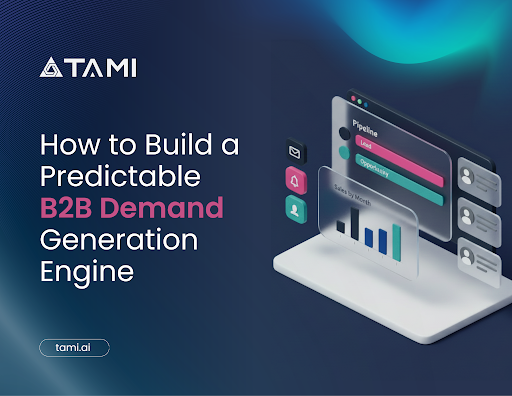
If your B2B demand generation results feel random, the problem usually isn’t your campaign ideas. It’s your data.
Predictable growth in B2B demand generation comes from clean targeting, accurate segmentation, and real-time intelligence. Without that foundation, even strong, creative and experienced sales teams will struggle to generate consistent pipeline.
After working with marketing and revenue teams across payments, logistics, fintech, and martech, one pattern shows up every time. The companies that win at B2B demand generation treat data as infrastructure, not as a one-off list purchase.
Let’s break down how to build a demand engine that is repeatable, measurable, and scalable.
1. Start with data quality
Most teams begin by asking, “What channels should we run?” or “Should we focus on outbound or inbound?”
That is the wrong starting point.
According to Gartner, poor data quality costs organizations an average of $12.9 million per year. In B2B specifically, inaccurate contact records and duplicate accounts directly reduce campaign performance and distort attribution. When your B2B lead generation strategy runs on outdated data, your funnel metrics lie to you.
Before scaling B2B demand generation, you need to answer three questions.
- Are your target accounts correctly classified by industry and sub-industry?
- Do you know which technologies, payment providers, or platforms they use?
- Are your contact records current, validated, and mapped to decision-maker roles?
This is where marketing data intelligence becomes the core driver of performance. Instead of blasting generic campaigns to broad segments, you can target companies by real attributes that signal buying intent or strategic fit.
For example, if you are selling a payments solution, knowing exactly which merchants use a competitor’s processor is far more valuable than targeting ecommerce companies in Europe. Precision fuels predictable B2B demand generation.
2. Define your total addressable market
Many teams talk about total addressable market, but few define it properly.
A predictable B2B demand generation engine requires clarity on your actual total addressable market, not just a theoretical number from an investor deck. That means identifying real companies that fit your ICP, validating they are active, and understanding their size, revenue signals, and technology stack.
McKinsey has repeatedly emphasized that high-performing growth companies prioritize granular market segmentation over broad industry targeting. This directly affects B2B lead generation efficiency.
When you can drill down by country, vertical, merchant size, payment provider, shipping partner, or cloud infrastructure, your targeting stops being generic. It becomes strategic.
This is one of the reasons we built TAMI around AI-driven market mapping rather than static SIC or NAICS codes. Traditional industry codes often fail to capture emerging digital sectors. AI classification allows you to segment markets based on what companies actually do online.
In practice, this means your B2B demand generation efforts are built on a live, accurate market view rather than outdated taxonomies.
3. Integrate CRM enrichment into your workflow
Even strong campaigns fail when the CRM is messy.
CRM enrichment is not a step after campaigns run. It is a continuous process that ensures every new lead, account, and contact is complete and accurate.
We’ve seen time and again that companies that invest in data governance and enrichment see measurable improvements in sales productivity and marketing ROI. That is because clean CRM data improves routing, personalization, and scoring.
A predictable B2B demand generation engine requires accurate firmographic data, verified contact information, up-to-date job titles, and clear account hierarchies.
Without CRM enrichment, your B2B lead generation engine starts to decay. Sales reps waste time chasing bounced emails. Marketing misattributes results because accounts are duplicated. Leadership questions the numbers.
In our own client work, we have seen email conversion rates improve significantly when verified inbox-level validation is applied before campaigns launch. Lower bounce rates protect sender reputation, which in turn sustains deliverability over time. That is how you make B2B demand generation scalable rather than short-lived.

4. Use real-time intelligence, not static lists
Here is where most demand engines break.
Teams buy a list, upload it to their CRM, run a campaign, and move on. Months later, half of those contacts have changed roles or left the company.
LinkedIn workforce reports consistently show high job mobility across industries, especially in tech and growth sectors. If your B2B demand generation relies on static data, your targeting degrades quickly.
Real-time alerts on job changes, company status updates, or technology shifts create a different dynamic. Instead of guessing who to contact, your team knows when a decision-maker joins a new company or when a prospect adopts a new payment provider or platform.
This is where marketing data intelligence becomes operational. It feeds directly into your CRM and triggers action.
For example, when a key contact moves to a competitor account, your sales team can engage immediately. When a merchant expands internationally, your demand strategy can adapt. That level of responsiveness turns B2B demand generation into a living system rather than a quarterly experiment.
5. Align sales and marketing around data
Predictable B2B demand generation only works when sales and marketing share the same data foundation.
If marketing defines ICP one way and sales redefines it in the field, your B2B lead generation metrics will never stabilize. Clean, enriched, shared CRM data reduces friction and guesswork.
It also improves qualification. When you can see which technologies a company uses, who they bank with, how they process payments, or which shipping partners they rely on, your messaging becomes specific. That specificity increases response rates and meeting quality.
Over time, you begin to see patterns. Certain segments convert faster. Certain technology stacks correlate with higher deal sizes. That feedback loop refines your B2B demand generation model.
At TAMI, we often see clients move from broad industry campaigns to highly targeted micro-segments once they trust the data. Instead of targeting fintech companies broadly, they target fintechs using a specific cloud provider and competitor product in a defined region. That is when conversion rates start to look predictable rather than random.
6. Measure predictability, not just volume
Many teams celebrate more leads. Very few measure stability.
A healthy B2B demand generation engine produces a consistent pipeline from defined segments over time. You should be able to forecast, with reasonable confidence, how many qualified opportunities a campaign type or segment will generate.
If results swing wildly from month to month, revisit your data inputs.
- Are you enriching new accounts consistently
- Are you refreshing existing records?
- Are you removing inactive or dormant companies?
When B2B lead generation is supported by ongoing CRM enrichment and strong marketing data intelligence, performance becomes less volatile. Campaigns do not rely on luck. They rely on structured targeting.
7. Build once, refine continously
There is no single tactic that guarantees predictable B2B demand generation. What works is a disciplined system.
If you want predictable growth, start by auditing your current data foundation. Look at bounce rates, duplicate accounts, outdated contacts, and misclassified industries. Then fix the core before scaling campaigns.
We have seen firsthand how clean, AI-driven market intelligence transforms B2B demand generation from reactive outreach into a strategic growth engine. When your CRM is accurate, your segmentation is precise, and your insights are current, pipeline stops being a guessing game.
Final thoughts
If you are serious about building a predictable B2B demand generation engine, start with your data. Audit it. Enrich it. Refresh it. Then build campaigns on top of something solid.
And if you need help with the core, try TAMI. Start your free trial today and let’s turn your B2B demand generation into a system that delivers consistent, measurable growth.