Cross-border ecommerce news is mostly a record of what already happened. A market report lands. A tariff changes. A marketplace announces a new region. By then the merchants involved have been trading there for months, and the suppliers who noticed early are already in conversation with them.
That gap is the opportunity. Expansion is visible on a merchant's own website long before it reaches a headline.
This guide covers where those signals appear, how to read the news that does matter, and how to build a list of expanding merchants rather than a reading list.
Why cross-border ecommerce news lags the market
Three problems limit what published reporting can do for you.
The first is timing. Official trade statistics are compiled, checked and released on a schedule. A quarterly figure describes a quarter that ended weeks ago.
The second is aggregation. National totals tell you a corridor is growing. They do not name a single company you could call.
The third is selection. News covers the largest players, because that is what readers recognise. Most cross-border growth sits with mid-market merchants nobody writes about.
None of this makes the news useless. It makes it context rather than a lead source.
Where the growth actually shows up first
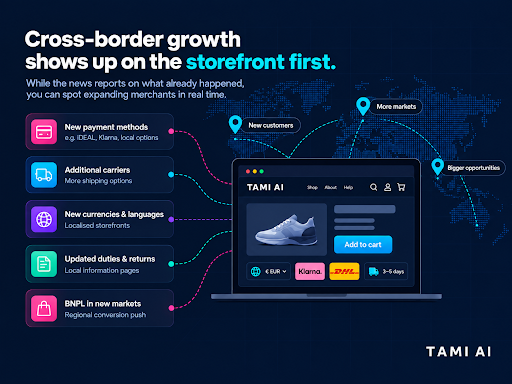
A merchant entering a new market has to change its storefront before it can sell. Those changes are public. Each one is a dated signal that something commercial has been decided.
Local payment methods appear at checkout
This is the clearest signal there is. A UK merchant adding iDEAL is selling into the Netherlands. Adding Klarna in a new market means a local conversion push. Payment methods are expensive to integrate, so nobody adds one speculatively.
A second or third carrier is appointed
Domestic merchants run one carrier. International ones run several, because service levels and duties differ by destination. A new carrier on the shipping page usually precedes a volume increase.
Currencies and language versions multiply
A localised price is a commitment. It means someone has modelled margin against a specific market, not merely enabled international checkout.
The returns and duties pages change
Duties, thresholds and returns addresses are the least glamorous pages on any site. They are also the most honest. A merchant that has published a local returns address has physical infrastructure in that country.
BNPL adoption in a specific region
Buy now, pay later is regional in a way most payment methods are not. Its appearance tells you which market a merchant is optimising conversion for, not just where it ships.
TAMI AI detects all of these from the live website, under European patent EP3289487. Payment providers, carriers, platforms and BNPL are read directly from the storefront. That turns single observations into a filterable segment. It is the point where research becomes pipeline, and the fastest route to a qualified list for anyone selling into ecommerce and retail.
How to read cross-border ecommerce news properly
Not all reporting carries the same weight. Rank your sources before you rank the stories.
Official statistics come first. The Office for National Statistics publishes UK trade and retail data with its methodology attached, so you can see what was measured.
Intergovernmental research comes next. UNCTAD tracks digital trade across developing and developed markets, which matters because corridor growth rarely follows the markets that dominate coverage.
Vendor reports come last. They are often useful and always commissioned. Check who paid, what was counted, and whether the sample resembles your market.
Then ask three questions of any figure. Which countries are included? Is it goods, services or both? Is the comparison against last year or against 2019? The answer to the third changes the story more often than anything else.
Which policy changes matter to international ecommerce
Regulation moves cross-border volumes faster than demand does. Three areas are worth monitoring directly rather than through secondary reporting.
Low-value import thresholds are the most consequential. When a de minimis exemption is removed or reduced, the economics of direct-to-consumer shipping change overnight for every merchant in that corridor. Check the position with the relevant customs authority before you quote it, because these rules have moved repeatedly and reporting on them ages badly.
VAT and import schemes are next. The EU's Import One-Stop Shop changed how sellers account for VAT on low-value consignments. The UK operates its own arrangements post-Brexit. Both determine whether a merchant can sell into a market without local registration.
Marketplace liability rules are the third. Where responsibility for compliance shifts to the platform, merchants change how they sell and often move to direct storefronts. That shows up as new domains, new payment stacks and new carriers.
What cross border commerce data shows that headlines cannot
Headlines describe markets. Cross border commerce data describes companies. The difference decides whether you finish with insight or with a list.
At the company level you can see which merchants ship to which countries, what they process payments with, who carries their parcels and what platform they run. TAMI AI holds this across 71 million companies, indexed from 402 million crawled websites. It classifies them using AI applied to live web signals rather than registered SIC codes. That matters in global online retail, where a registered classification rarely reflects what a company sells or where.
It also answers questions no report will. Which UK merchants started shipping to Germany this quarter. Which retailers use a specific processor and turn over more than a set threshold. Those are commercial questions. They need market research built on company records, not national aggregates.
How to turn this into a target list
Four steps take you from reading to pipeline.
Start with the corridor, not the sector. Decide which route you want to sell into. UK to Germany behaves nothing like UK to the United States.
Filter on the signal that indicates commitment. Local payment methods and a local returns address outrank a generic shipping policy.
Check recency. A merchant that added a market two years ago has already chosen its suppliers.
Then get to the right person quickly. Expansion decisions sit with operations, finance and logistics leads, not with marketing. Reaching them depends on current contact records. This is where B2B lead generation either works or stalls, and where teams selling into logistics find the shortest path to a conversation.
Read the news, work the signals
Cross-border ecommerce news is worth following for context, policy and direction. It will not tell you which merchant expanded last month. That sits on the merchant's own website. Look at the payment methods, carriers and currencies added since you last checked.
Track the signals and the news stops being something you react to. It becomes confirmation of a market you were already selling into.
See which merchants entered your target corridor recently. Book a TAMI AI demo and we will build the segment live.