

By the time a prospect fills in a form, the decision is usually half made. Gartner's research on the B2B buying journey found that buyers spend around 17% of their purchase process meeting potential suppliers, and that time is split across every vendor on the shortlist.
Buyer intent signals exist to get you into the conversation before the shortlist is drawn, and the teams that do this well are not tracking more signals than everyone else. They are tracking fewer, with a clear reason for each one.
This guide covers the nine worth your attention in 2026, what each one actually indicates, and what to do in the days after it fires.
What are buyer intent signals, and which ones actually matter?
Buyer intent signals are observable pieces of evidence that a company is moving towards a purchase in your category. They fall into three groups, and confusing them is why so many signal programmes produce noise.
Behavioural signals come from what someone does on your own property: pages viewed, pricing checked, a demo video watched to the end. They are accurate, and they are late, because a company researching you is already aware of you.
Operational signals come from what a business changes about itself. New technology at the checkout, a different carrier on the shipping page, a job advert for a role that did not exist last quarter. These are earlier and far less contested, since your competitors are mostly watching their own forms.
Third-party intent data comes from a vendor aggregating content consumption across publisher networks. It tells you a topic is being researched somewhere inside an account. It rarely tells you by whom, and never tells you why.
The nine signals below are weighted towards the second group, because that is where the advantage is still available.
The 9 buyer intent signals to track in 2026
Each one includes what it means and what to do next. Treat the response window as part of the signal, since a stale signal is just a fact.
1. A change in the technology a company runs
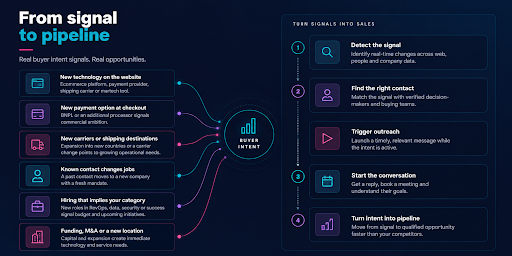
When a prospect adds, removes or swaps a platform, something inside that business has a new budget, a new owner and a new set of problems. A retailer replacing its ecommerce platform is rebuilding integrations for months afterwards. A company that has just added a customer data platform has money approved for data work.
TAMI AI detects technology from a company's live website, covering ecommerce platforms, payment processors, shipping carriers and martech, so a change registers as a market event rather than as something a rep happens to notice. Act inside a fortnight, while the implementation is still open and adjacent decisions are still being made.
2. A new payment provider or BNPL option at checkout
Payment changes signal commercial ambition more reliably than almost anything else a company publishes. Adding buy now, pay later points to a push on conversion and average order value. Adding a second processor usually means either international expansion or dissatisfaction with the first.
For anyone selling into ecommerce and retail, this is the signal that separates a merchant who is scaling from one who merely exists. It also gives a specific opening, because you can reference the change itself rather than the sector.
3. A shift in carriers or shipping destinations
A merchant shipping to three new countries has taken on duties, returns, tax and fulfilment complexity in each one. That is a company with fresh operational pain and a leadership team already spending to solve it. A carrier change signals the same thing from a different angle, usually cost or reliability pressure at volume.
This is detectable from the live site, and TAMI AI surfaces carriers and cross-border activity alongside the rest of the company record, which is what makes it usable as a segment rather than as a one-off observation.
4. A known contact changing jobs
Someone who bought from you, liked you, or simply took your calls has arrived somewhere new with something to prove and a budget to spend. This is the highest-converting signal available to most teams, and the most consistently wasted, because the CRM record still points at the old employer and the old email address.
Continuous CRM data enrichment closes that gap by updating records as people move. The window here is short. Reach out in the first ninety days, while the new starter is still reviewing what they inherited.
5. Hiring that implies your category
Job adverts are the most candid document a company publishes. A first RevOps hire means the data problem has been acknowledged. Three SDR roles at once means the pipeline target has gone up. A head of international means the expansion is funded rather than discussed.
Read the requirements section rather than the title, because that is where the current stack and its gaps are listed in plain language.
6. Funding, acquisition or leadership change
Capital events reset priorities. New money is spent against the plan that raised it, and a new executive replaces tools associated with their predecessor within the first two quarters. Both are public, both are easy to monitor, and both are worth more when you already know what that company runs, since you can tell the difference between a rebuild and a top-up.
7. Movement among your competitors' customers
A company running a competing product is pre-qualified in a way no cold account ever is. They have a budget line, an internal owner and an established view of the category. The relevant question is when their agreement ends and whether they are getting what they expected.
Building a view of your competitors' customer base turns that into a working list rather than a hunch, particularly where the competing tool is visible on the site.
8. Traffic and audience growth
Sharp growth in visitors or audience size creates strain that shows up in hiring, tooling and process within a couple of quarters. The signal is the rate of change rather than the absolute number, so a small company doubling matters more than a large one holding steady.
9. Third-party intent data, used with discipline
Topic surge data has a real use: prioritising accounts you were already going to work. It has a common misuse, which is treating an anonymous spike as a reason to call someone who has never heard of you.
Two limits are worth holding onto. The signal is account-level, so it does not tell you which of nine hundred employees was reading, and much of the underlying identification depends on IP resolution and cookies, which is why UK teams should read any such programme against the ICO's guidance on direct marketing and privacy before it reaches a call list.
What AI tools help with buyer intent signals?
This is where most teams are currently spending, so it is worth being precise about what the technology does and does not do.
AI is genuinely good at three jobs here.
It classifies companies from unstructured web content, which is how you identify what a business actually sells rather than what its registered code claims. It watches for change across a market continuously, which no human team can do at scale. And it summarises what fired, for which account, in what order of importance.
AI is poor at one job that vendors frequently sell: inferring intent where no evidence exists. A model given thin data produces a confident score, and a confident score built on nothing is worse than no score, because it gets actioned.
The practical shift in 2026 is that these signals can now be queried in conversation rather than exported. The TAMI AI MCP server connects Claude, ChatGPT or your own agent to live company, contact and technology data, so a question like which UK merchants added a BNPL provider and ship to more than five countries is answered in the tool a rep already works in.
That removes the delay between a signal existing and somebody noticing it, which is usually where the value leaks out.
How do you turn signals into a workflow?
A signal that nobody owns is a fact in a dashboard. The signal firing is the input. What happens after it separates a programme that changes pipeline from one that gets quietly abandoned.
Decide what each signal earns. Weight by evidence strength, not by how easy the data was to obtain. A champion changing jobs outranks a topic surge every time.
Set a decay window per signal. A funding round stays relevant for months. A checkout change is worth acting on for weeks. After the window closes, the record should stop appearing in the queue rather than sitting there permanently.
Name an owner and a response. Whoever receives the alert should know what the first action is before it arrives, which usually means a specific opening line rather than a task called "research account".
Review what converted each quarter and remove signals that did not. Most teams need three or four working well, not nine. Sales leaders who prune aggressively get a faster team than those who add another feed.
Track fewer signals, act on them faster
The advantage in 2026 does not come from tracking more buyer intent signals than a competitor. It comes from watching the ones they cannot see, meaning operational change inside the businesses you sell to rather than form fills on your own site, and from closing the gap between a signal firing and someone acting on it. Three signals with owners beat nine on a dashboard.
Find out which companies in your market changed something worth calling about this month. Book a TAMI AI demo and we will build the segment live.