
Email campaign optimization now starts before you even write the subject line
Most email campaign optimization is about subject lines and send times. None of it helps if the message never arrives. TAMI AI starts one step earlier, with a list verified to reach the inbox.
TAMI AI verifies every contact at inbox level before it reaches your list, holds bounce under 5% against an industry norm above 20%, and maintains a managed suppression process, so campaigns launch against records that will actually arrive.
95% deliverability. Under 5% bounce. Verified at inbox level.
No card needed. Check a sample of your list before your next send.
Bad lists no longer just underperform. They get you blocked.
Since February 2024, Google and Yahoo have enforced hard rules on bulk senders, with Microsoft following in May 2025. Fail them and mail is refused at the server, never reaching a spam folder to be found later.
What is email campaign optimization?
Email campaign optimization is the work of improving how a campaign performs, from subject lines and send times through to segmentation, creative and list quality. Most guidance concentrates on the message. Almost none of it addresses whether the message arrives.
That order is now backwards, because open rate is a metric you can only improve on mail that landed. A campaign refused at the server has no open rate to test. Optimization runs in sequence. Get the list, the authentication and the suppression process right first, then spend your time on the copy.
Why good campaigns underperform
Three failures, and none of them are visible in your campaign report.
The list was guessed
Pattern-generated addresses look identical to verified ones until the send. Bounces at volume signal an unmaintained purchased list, and reputation damage follows the pattern rather than the individual address.
Sender rules failed
Bulk senders need SPF, DKIM and DMARC, plus one-click unsubscribe honoured within two days. Missing any of them means rejection at the server, which never appears as a deliverability problem in your ESP.
Suppression is fragmented
Opt-outs live in one tool, the CRM holds another list, and a third sits in a spreadsheet. Contacting someone who objected is a compliance failure, and it drives the complaints that trigger enforcement.
Email campaign optimization starts upstream.
Verified contacts, documented suppression, and a list built to survive the sender rules, before anyone argues about subject lines.
YOUR SENDING DOMAIN IS AN ASSET YOU CAN DESTROY
It takes two years to warm and one campaign to ruin.
Reputation is also scored on patterns, not single sends. One campaign against a decayed list teaches every provider that your domain mails dead addresses. Recovery takes longer than the campaign did.
Run a sample of your list through TAMI and see how many addresses would have bounced. Before the send, not after.
WHAT OUR CLIENTS THINK OF TAMI AI





Which UK audiences can you email through TAMI AI?
Here are the top verticals our customers build campaign lists in, and the targeting behind each.
-
Payments and fintech
Decision-makers at merchants, filtered by processor and BNPL adoption.
Explore payments → -
eCommerce
Contacts at genuine trading merchants, with dormant storefronts excluded.
Explore eCommerce → -
SaaS and tech
Buyers at companies running the platforms you integrate with.
Explore SaaS → -
Logistics
Commercial contacts mapped to carriers and shipping corridors.
Explore logistics → -
Manufacturing
Decision-makers at firms modernising systems and ordering online.
Explore manufacturing → -
Retail
Contacts at multi-site and cross-border operators.
Explore retail →
Our European patent for merchant detection is what lets a campaign segment on what a business actually runs, so the message matches the recipient rather than the industry code.
Three questions to ask before your next send
One
What percentage of this list was verified in the last month, and how?
Two
Does every system we use check the same suppression list?
Three
If this campaign bounces badly, what happens to the domain we send from?
Not a bigger list. A list that arrives.
Reach is what lands, not what you exported. Every TAMI AI contact is confirmed before it reaches the file.
What makes a list survive a send
Volume is easy. These are the things that decide whether the campaign arrives.
Inbox-verified addresses
Confirmed the address accepts mail, not generated from a naming pattern.
Continuous re-verification
Records re-checked as people move, so the list is current at send time.
Trading status
Dormant companies excluded, because dead domains bounce hardest.
Managed suppression
Opt-outs handled centrally and documented, not scattered across tools.
Segmentation depth
Filter by technology, payments and carrier, so relevance reduces complaints.
Deduplication on import
One person, one record, so nobody receives the same campaign twice.
Deliverability starts before you press send.
Complaint rate is driven by relevance as much as consent. Segmenting on what a company runs is a deliverability tactic, not just a targeting one.
WE VERIFY BEFORE THE LIST EXISTS, NOT AFTER IT FAILS
Most teams buy a list, send to it, then clean up what bounced. That sequence damages your domain before anyone learns anything. TAMI AI confirms an inbox accepts mail before the record enters the database, so the clean-up step never has to happen at your reputation's expense.

458M+
CONTACTS


REAL TIME
REFRESH


What comes back when you build a campaign list with TAMI AI
Not a CSV and good luck. Six things, all aimed at arrival.
- Verified contacts Confirmed at inbox level, holding bounce under 5%.
- Segment definition you can reuse Saved criteria, so the next campaign starts from the same logic.
- Company context per contact What each business runs, ships and processes payments through.
- Suppression applied Opt-outs and existing customers removed before export.
- CRM and ESP delivery Straight into Salesforce, HubSpot, Pipedrive, Close, Mailchimp or Salesloft.
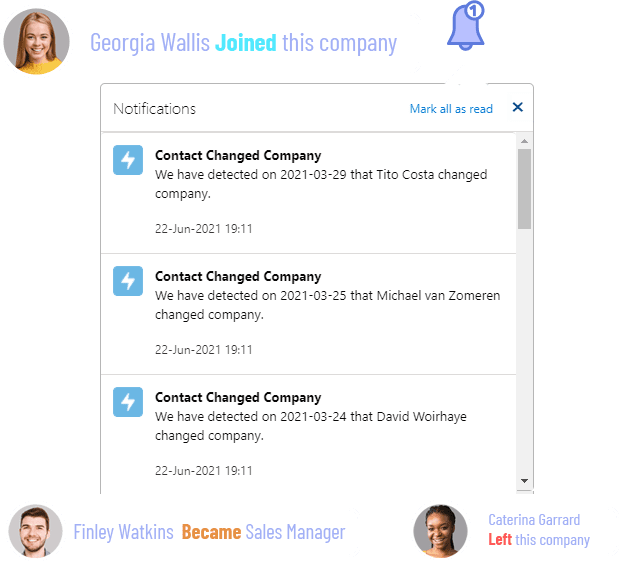
- Change alerts afterwards Job moves flagged, so sequences stop before they bounce.
Is buying a B2B email list legal in the UK?
Yes, with documented sourcing. PECR's electronic mail rule excludes corporate subscribers, so emailing a limited company needs no prior consent. Sole traders and some partnerships count as individuals, making that exemption narrower than most teams assume. UK GDPR still governs the record. TAMI AI sources directly, so provenance stays traceable.
How TAMI AI compares to a B2B email list provider UK teams already know
Two platforms UK teams evaluate alongside us, and what each does best.
| Marketscan | Data HQ | TAMI AI | |
|---|---|---|---|
| How the data is built | Blended from five sources | Compiled and verified | Read from live websites |
| Refresh cycle | Monthly rebuild | Ongoing additions | Continuous |
| Technology stack targeting | No | No | Yes |
| Payments and BNPL segmentation | No | No | Patented |
| Shipping and carrier targeting | No | No | Yes |
| Trading status from live site | No | No | Yes |
| Job change alerts to your CRM | No | No | Yes |
| Self-serve platform access | Online list builder | Consultative | Full platform |
| Free tier to test the data | No | No | Yes |
How to optimize a B2B email campaign, in six steps
Fix authentication before anything else
SPF, DKIM and DMARC are the price of entry for bulk senders, and one-click unsubscribe must be honoured within two days. This part sits with your IT or ESP, not with us, and nothing else you do matters until it is done.
Verify the list at send time, not purchase time
A list checked in March is a different list in June. Because TAMI re-verifies continuously and confirms each inbox accepts mail, the export you take this week reflects this week rather than the day a file was assembled.
Centralise suppression
One list every system checks, not one per tool. Exports run against your CRM on import, so existing customers, open opportunities and anyone who has objected are removed before the list reaches your ESP.
Segment for relevance, not just for size
Complaint rate falls when the message obviously applies. Filtering on the platform a company runs, the processor it uses or the carrier it ships with gives you something specific enough to justify landing in someone's inbox.
Watch complaints, not just opens
Google wants spam complaints under 0.1% and enforces at 0.3%. Yahoo calculates against inbox-delivered mail, so identical complaints score worse. Postmaster Tools shows you both, and a tighter segment is the fastest way to move the number.
Protect the domain before the campaign
Warm gradually, keep bounce low, and never send volume to an unverified list. TAMI holds bounce under 5% against the 20% typical of bought data, which is what keeps a sending domain worth the two years you spent warming it.
Subject lines change open rate by a few points. Deliverability changes whether there was anything to open at all. Fix the list first, then spend a week on the copy.
WHAT TEAMS DO WITH IT
 Build UK campaign lists that clear the sender rules
- Segment on technology, payments and carrier
- Suppress customers and opt-outs before export
- Reuse saved segment definitions per campaign
- Export straight to your ESP or CRM
- Hold bounce under 5% across every send
- Keep suppression centralised and documented
- Evidence lawful basis and sourcing on request
- Catch job moves before sequences break
- Protect the sending domain as an asset
One bad list costs more than a year of good data. See what yours would do before you send it.
WHAT THE INBOX PROVIDERS NOW REQUIRE
Google and Yahoo began enforcing in February 2024, and Microsoft followed in May 2025.
- Bulk senders, meaning anyone sending 5,000 or more messages a day to Gmail, need SPF, DKIM and DMARC, one-click unsubscribe, and spam complaints below 0.3%.
- Non-compliant mail is rejected outright rather than filtered, and bulk classification does not expire when volume falls.
NO CUSTOM DEVS. JUST PLUG IN
With TAMI AI, building a verified UK contact list takes minutes. Setup is instant. Data starts flowing straight away. Here's what TAMI AI integrates with:





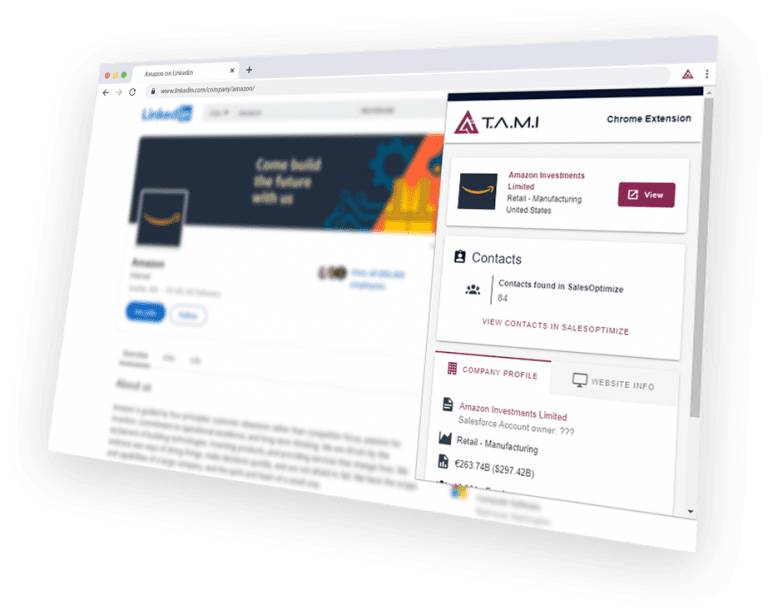
QUALIFY A COMPANY WITHOUT LEAVING THE TAB
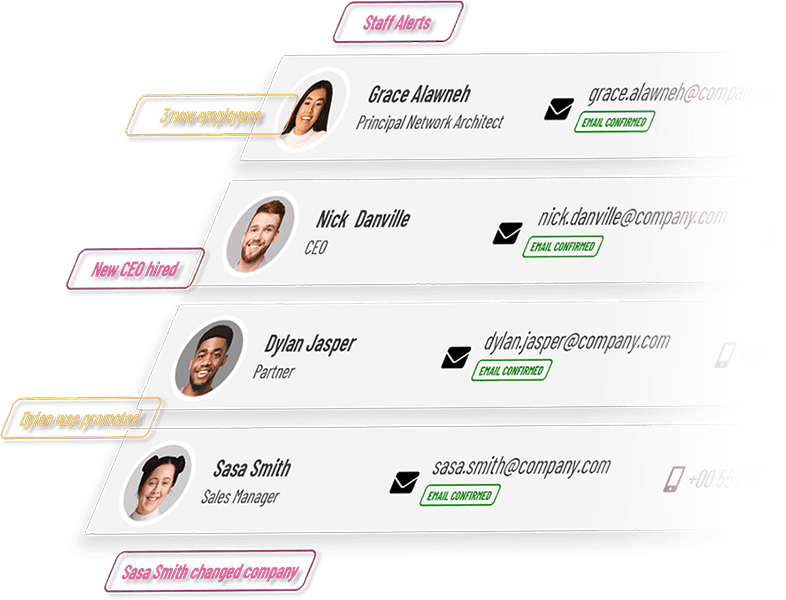
Pull verified contacts, tech stack, payment providers and merchant data from any company site or social profile while you're already looking at it. Export straight to your CRM.
- Website
- Facebook
- Twitter
Send us your segment definition and we'll tell you how many UK companies match it, and how many are showing activity this month.
Explore more solutions
Every solution runs on the same UK dataset. Pick the problem you're solving today.
Frequently asked
questions
Stop finding out from the bounce report
Check your next campaign list before it reaches your ESP, and see what would have failed.