

B2B buyers used to open ten browser tabs. Now they open one ChatGPT window. That shift is the whole story. The question most GTM teams are asking right now: how is AI search changing B2B buyer behavior?
The answer starts with the obvious consequence. Buyers get answers without ever visiting your site. Shortlists form before you know the buyer exists. Research cycles that took weeks now take an afternoon.
The rest of this piece covers what that means for your pipeline, where self-serve buyers are landing, and what precision targeting actually requires in 2026.
The new reality: buyers who don't need you to buy
B2B buyers were already moving away from vendor-led research before AI arrived. Gartner found that 67% of B2B buyers prefer a rep-free experience, while 45% used AI during a recent purchase. Buyers were already moving toward self-directed research before generative AI became part of the process. AI search has accelerated that shift and changed the mechanism.
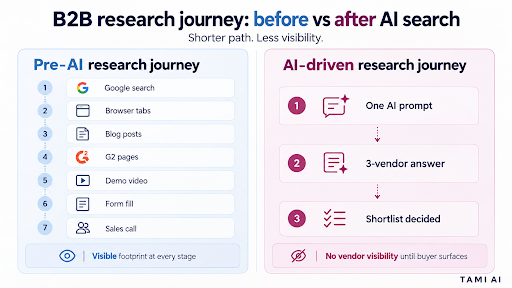
Before AI assistants, self-serve meant Googling, reading five blog posts, comparing three G2 pages, and watching a demo video. The seller still got signals from every one of those actions. Analytics logged the visit. Marketing automation fired a scoring event. A rep eventually got an alert.
With AI search, none of that happens. A buyer asks Perplexity "what's the best alternative to Apollo for European prospecting" and gets a synthesised answer with three recommendations. No site visit. No form fill. No attribution trail. The seller is either in that answer or they aren't.
How is AI search changing B2B buyer behavior? Six shifts that matter
Six specific changes are reshaping how deals start. Each one has a direct pipeline consequence.
Discovery happens inside the AI, not on your site. Buyers ask a model and get a shortlist. If you're not in the training data or the retrieved sources, you're not in the shortlist. The traffic you used to earn now bypasses you entirely.
Shortlists form earlier. Forrester found that 92% of B2B buyers already had a shortlist when they began the buying process, while 41% had a single vendor in mind. Credibility is often established before sales ever enters the conversation.
Research is faster and shallower. AI gives one answer, not twenty. Buyers accept it, especially under time pressure. Depth of comparison is dropping.
Branded search is losing ground to intent-led queries. Instead of searching "TAMI pricing" buyers ask "what's the cheapest B2B data provider for ecommerce prospecting." The intent is still there. The branded signal isn't.
Attribution is breaking. AI referral traffic rarely passes clean source data. You can't see which model recommended you, which prompt triggered it, or how often it happens.
The window to influence is shrinking. When a buyer surfaces, they've often already picked. You get one shot, with less context than you used to have.
The self-serve buyer is now the default
Self-serve buyers used to be a segment. Now they're the baseline. McKinsey's research on B2B sales finds digital-first buyers are now the majority across every segment and region. Treating them as an exception is how pipelines dry up.
What the self-serve buyer actually wants is specific. Clear pricing on your website, not "contact sales." Honest comparison content, not a landing page that pretends competitors don't exist. Deep product information available without a gatekeeper. Social proof that reads real, not stage-managed. And answers to the questions they'd ask an AI, published on pages the AI will actually quote.
This last point is the one most B2B teams underinvest in. AI search engines pull from pages that answer specific questions with specific, extractable answers. Pages that bury the answer behind narrative or hide it behind a form don't get cited. Pages that answer directly, with named sources and clear structure, do.
That's the whole mechanic of generative engine optimisation, and it's why content strategy has shifted from traffic generation to citation generation.
Google's rollout of AI Overviews across Search has pushed this behaviour mainstream, with AI-generated summaries now surfacing above traditional organic results for a growing share of queries.
What this breaks in the traditional B2B buyer journey
The traditional B2B buyer journey assumed a predictable path. Awareness, consideration, decision. Each stage left a visible footprint. Marketing scored it. Sales followed up.
AI search collapses that path. A buyer can jump from "I think I have a problem" to "I've picked a vendor" inside a single session with no stage-by-stage trail. The journey still exists. You just can't see it. Which means waiting for signals before you engage is now a losing position for most of your TAM.
The teams adapting fastest are moving from a reactive model (wait for signal, then respond) to a proactive one (identify fit, trigger outreach, create signal).
By the time a buyer surfaces, a shortlist already exists and the window to influence it is narrow. Building that proactive layer takes the right signal-based selling tools and a workflow that triggers on real buying signals rather than static lists.
Precision targeting is now the only way to win
If buyers finish their research without you, you have to reach them before the research starts. That requires precision, not volume. Spraying your ICP list and hoping for the 5% who happen to be in-market is a shrinking game.
Finding the specific accounts that fit, with the specific stack signals that suggest readiness, with verified contacts you can actually reach, is the growing one.
The four pillars of precision targeting
Precision targeting rests on four things that have to work together:
- Accurate account identification. Knowing who the account actually is, not what SIC code it was assigned decades ago.
- Deep stack and firmographic context. The specific technology, payment, and infrastructure signals that reveal fit.
- Real-time signal detection. Catching the moment of readiness, not reading about it next quarter.
- Verified contact data that doesn't bounce. All the targeting precision in the world collapses if your email never arrives.
Miss any one of them and the precision collapses back into volume outreach dressed up as personalisation.
Where TAMI fits in
TAMI's model is built around these four pillars. It identifies accounts through AI-based classification rather than SIC or NAICS codes. The technographic layer runs deep (payment, shipping, ecommerce platform, martech, BNPL, banking, hosting) and refreshes in real time. Every account comes paired with verified contacts kept under a 5% bounce rate.
The merchant intelligence layer, backed by a European patent for ecommerce merchant detection, covers categories most generic providers skip. For teams reaching buyers before AI search finishes the shortlist, that combination is what turns ideal customer profiling from a slide-deck exercise into working targeting.
A UK martech team comparing TAMI against Apollo, ZoomInfo, and Cognism saw a 10x higher inbound conversion rate and 95% email delivery. Precision data let their outreach land before competitors even entered the conversation.
How to adapt (five practical moves)
The teams responding well to AI search aren't rebuilding their GTM from scratch. They're making five practical moves.
Audit which AI assistants mention you. Ask ChatGPT, Perplexity, Claude, and Gemini the questions your buyers ask. If you're not in the answer, you have a visibility problem.
Rewrite your highest-intent pages for AI extraction. Clear question, direct answer, named stats, structured headings. Pages that read like FAQs get cited more than pages that read like essays.
Publish comparison content honestly. "Us vs them" pages written with integrity get cited by AI tools. Puff pieces get skipped.
Invest in precision data. If your targeting is still demographic (industry, size, geography), it’s a step behind buyers whose research is now surgical. The upgrade starts with better B2B data enrichment for your sales team and a classification layer that actually reflects modern businesses.
Move from reactive to proactive outbound. Signal-based motions that reach buyers before they finish self-serving are the only pattern that holds up against AI-collapsed buying journeys.
Frequently Asked Questions
The bottom line
AI search is changing B2B buyer behavior faster than most GTM teams are adapting. Buyers find vendors through AI. Shortlists form before you see signals. Attribution breaks. Volume outbound stops working.
The response isn't more content or more automation. It's precision. Reaching the right accounts, at the right moment, with context specific enough that your outreach lands before competitors enter the frame.
If your pipeline depends on buyers finding you, that model is losing ground every quarter. Book a demo of TAMI and see how precision data, AI classification, and verified contacts give you a path to the buyer before AI search finishes the shortlist.