
Inside User Reviews: Best Apollo.io Alternatives in 2026
27/07/2026
AI SDRs in 2026: The Hype, the Gap & Where Data Still Wins
27/07/2026
Cold outreach in 2026 doesn't work the way it used to, and the numbers say so cleanly. The industry average reply rate now sits at 3.43%, while emails referencing a specific trigger event hit 18%. Signal-based outreach converts to meetings at 2-4% versus 0.5-1% for cold. And in a 2026 benchmark of 94 B2B companies, the teams running signal-based selling posted a 32% win rate against 13% for list-based ABM.
This guide walks through the entire signal-based selling ecosystem, the process for actually using it, and the 10 tools that matter in each layer of the stack.
What is signal-based selling?
Signal-based selling is a B2B sales methodology that uses observable events (funding rounds, job changes, tech installs, website visits, intent surges, hiring spikes, and similar triggers) to identify accounts entering a buying window. Then, it prioritises outreach to those accounts based on the strength and recency of the signals detected.
The core insight comes from the 95-5 rule: at any given moment, roughly 5% of your total addressable market is actively in a buying window. The other 95% will not engage meaningfully with outbound no matter how good the copy is. Signals get you on the shortlist for the 5% that will.
The reason it works is timing. Buyers now complete 60-67% of their journey independently before engaging a seller, which means by the time a form is filled, three competitors are already in the deal. Signal-based selling flips that.
Instead of waiting for the form fill, you reach out during the invisible research phase, referencing the specific event that made you relevant. That's why trigger-referencing emails convert 5x above generic cold.
The signal categories that matter in 2026
Not every signal is worth acting on. The categories below are the ones that consistently produce pipeline, ordered roughly by intent strength (highest first):
- First-party website signals: someone from your target account is on your pricing page. Highest intent, shortest window.
- Job change signals: a champion who used your product moves to a new company, or a decision-maker in your ICP takes a new role. High intent, 30-90 day action window.
- Technographic signals: a target account installs a competitor, adopts a complementary tool, or churns off an incumbent. Strong intent, especially for displacement plays.
- Funding and expansion signals: a target account raises capital, announces an expansion, or opens offices in a new market. Budget signal, 60-180 day window.
- Hiring signals: a target account posts 20 SDR openings, a new VP of Sales, or roles that indicate scaling a specific function. Structural intent.
- Third-party intent data: Bombora, G2, TrustRadius show research surge on topics relevant to your product. Tier 2 signal, useful when combined with others.
- Community and social signals: LinkedIn engagement with content on your category, community activity, competitor complaints.
- News and PR signals: layoffs, acquisitions, executive quotes, industry announcements affecting your target accounts.
The strongest signal-based teams stack these. Combining two or more signals on the same account converts at 5-10x the rate of single-signal outreach, and that is exactly where the real leverage lives.
The 7-step process for signal-based selling
Tools alone don't produce pipeline. The process below is what turns raw signal detection into meetings booked.
Step 1: Define your trigger criteria
Not every signal deserves outreach. Score each signal type by historical correlation with your closed-won deals. Drop anything below 60% accuracy, or that produces mostly noise.
Step 2: Detect signals across your TAM
Use dedicated tools per signal category (covered below). This is the visibility layer.
Step 3: Verify the account and enrich the signal
This is the crucial step. A raw signal ("someone at TechCo just changed jobs" or "AcmeCorp installed Klarna") is useless without knowing who TechCo actually is, whether they fit your ICP, what their tech stack looks like, and who to email.
TAMI's role in the stack is this enrichment layer: real-time company intelligence, AI-based classification (not SIC/NAICS guesswork), tech stack and merchant detection, and verified contacts with sub-5% bounce rates.
Without this step, signals stay abstract. With it, every triggered signal becomes an actionable account with a rep-ready contact record. This is also where TAMI acts as a signal source in its own right, surfacing tech stack changes, new payment provider adoption, ecommerce platform migrations, and cross-border expansion the moment they happen.
Step 4: Score and prioritise
Rank surfaced accounts by combined signal strength. Fresh, stacked signals (two or more within seven days) go to the top. Older or single signals go to nurture.
Step 5: Route with context
Assign each account to the right rep with the full signal history and enriched contact record attached. Speed matters here. New VP hire signals have a 30-90 day window. Intent surge has 7-14 days.
Step 6: Personalise outreach using the signal
Reference the specific trigger in the message. This is the entire reason signal-based converts 5x above generic. Don't waste the signal by sending a template.
Step 7: Measure and refine
Track reply rate, meeting rate, and pipeline generated per signal type. Kill the signals that don't convert. Double down on the ones that do.
For the wider view on where this connects into demand generation as a whole, our breakdown of a predictable B2B demand generation engine covers how signal-based selling plugs into the top of the funnel.
Quick comparison of the 8 top signal-based selling tools
Now that you know the process flow, here are 10 tools you can use to deliver optimal results with your signal-based selling.
|
Tool |
Signal type |
Best for |
Standout |
Starting price |
|
Bombora |
Third-party intent |
Enterprise intent monitoring |
4,000+ site co-op, topic surge data |
Custom |
|
TAMI |
Technographic + merchant + enrichment |
Ecommerce, payments, cross-border |
Real-time refresh, sub-5% bounce, patent-backed merchant detection |
Custom |
|
G2 Buyer Intent |
Review-site intent |
Category-specific research signal |
Own-category buyer surge |
Custom |
|
RB2B |
Website deanonymisation |
US B2B website visitor identification |
Person-level, not just company |
$189/mo |
|
Warmly |
Website intent + deanonymisation |
Warm intent activation |
Live visitor alerts + chat |
Free-$$$ |
|
Common Room |
Community/social signals |
Product-led and community-driven GTM |
Unifies Slack, Discord, GitHub, LinkedIn |
Custom |
|
Crunchbase |
Funding + news signals |
Series A-C prospecting |
Funding rounds, M&A, exec moves |
$49/mo |
|
Clay |
AI signal orchestration |
Multi-signal enrichment workflows |
Waterfall enrichment, automation |
$149/mo |
1. Bombora (Third-party intent)
Best for: Enterprise teams monitoring intent across a broad TAM.
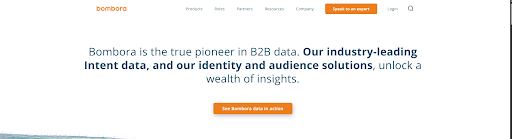
Bombora is the largest third-party intent data provider, running a co-op of 4,000+ B2B publisher sites that track topic-level research surges across companies. If your target account starts consuming content on topics relevant to your product, Bombora flags it.
What it does well: Coverage breadth. Topic-level granularity across a huge co-op.
Where it falls short: IP-based identification misses remote workers on home internet (35-45% of the B2B workforce in 2026), and there's typically a 1-7 day lag between behaviour and delivery. Treat as tier 2, not tier 1.
Verdict: Useful as a supporting signal layer, especially at enterprise scale. Not the highest-intent signal in your stack.
2. TAMI (Technographic, merchant, and enrichment layer)
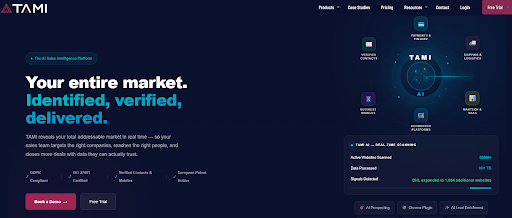
Best for: Any team whose signal-based motion falls apart at the enrichment and contact layer.
TAMI plays two roles in a signal-based stack. First, as a signal source: real-time detection of tech stack changes, payment provider adoption, ecommerce platform migrations, BNPL installs, and cross-border expansion.
Second, as the enrichment layer that makes every other signal actionable: AI-based company classification, real-time firmographic refresh, and verified contact data with sub-5% bounce rates.
What it does well: Real-time refresh, depth of stack detection including payment and shipping, and verified contacts. For teams whose signal stack lives inside ecommerce or payments, our ideal customer profiling breakdown covers how TAMI's classification depth changes what filters are actually possible.
Where it falls short: TAMI is a specialist. It's not the right pick if your ICP is broadly cross-industry with no commerce or technology-stack angle.
Verdict: The crucial enrichment step every signal has to pass through to become a real outbound target, and a strong standalone signal source for commerce-focused motions.
3. G2 Buyer Intent (Review-site intent)

Best for: Category-specific intent, particularly when your product sits in a well-defined G2 category.
G2 surfaces which companies are researching your category, comparing you against competitors, or reading reviews on your product. It's one of the highest-intent third-party signals because the buyer is on a review site, which means they're actively evaluating.
What it does well: Bottom-funnel intent. Direct comparison-shopping signal.
Where it falls short: Only works if you're in a G2 category with meaningful review volume.
Verdict: Strong bottom-funnel signal for SaaS categories. Less useful for niche or emerging categories.
4. RB2B (Website deanonymisation)
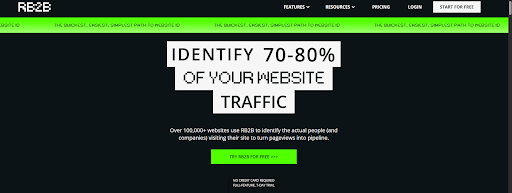
Best for: US-focused B2B teams wanting person-level identification of anonymous website visitors.
RB2B identifies individual visitors on your website, not just companies. If a Head of Growth from a target account lands on your pricing page, RB2B tells you exactly who they are and pushes the alert to Slack.
What it does well: Person-level identification, US coverage, real-time speed.
Where it falls short: US-only, so useless for European or global motions. Privacy-sensitive teams sometimes hesitate to use it.
Verdict: Highest-intent first-party signal available for US B2B. Pair with fast outbound.
5. Warmly (Website intent and deanonymisation)
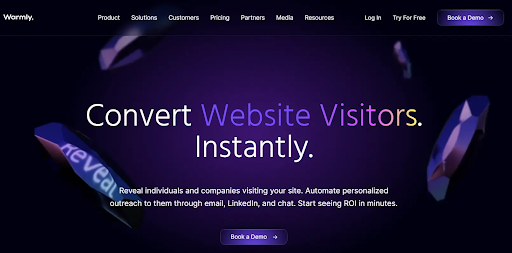
Best for: Warm intent activation on high-intent site visitors.
Warmly identifies company visitors, surfaces intent based on pages viewed, and enables live sales chat or triggered outbound in real time. The play is turning anonymous traffic into pipeline while the visitor is still on the site.
Warmly is expected to be absorbed into HubSpot's Smart CRM and Data Hub over the next few quarters. If you're evaluating Warmly as a standalone signal tool, factor in that its independent roadmap has effectively ended, and consider whether you're already a HubSpot customer (which makes the acquisition an upside) or on Salesforce (which makes long-term integration a bigger question).
What it does well: Live activation, integrations with sales stack, useful free tier.
Where it falls short: Company-level rather than person-level in many cases. Deeper intent depends on visitors reaching pricing or product pages.
Verdict: Good addition to any inbound-heavy motion. Best when paired with a rep team ready to act within minutes.
6. Common Room (Community and social signals)
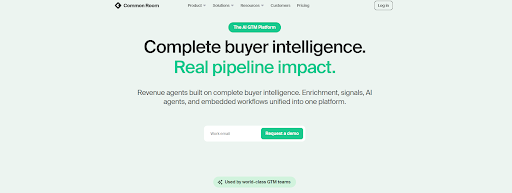
Best for: Product-led and community-driven GTM motions.
Common Room unifies signals across Slack, Discord, GitHub, LinkedIn, and other community surfaces, so you can see which prospects are engaging with your brand, competitors, or category in public conversations. Particularly powerful for open-source, developer-tools, or community-heavy categories.
What it does well: Deep community coverage. Reveals engaged prospects who never fill a form.
Where it falls short: Only useful if your buyers actually live in these surfaces. Less relevant for traditional enterprise B2B.
Verdict: Strong pick for modern GTM motions where the audience is community-first.
7. Crunchbase (Funding and news signals)
Best for: Prospecting into Series A-C companies during their expansion window.
Crunchbase covers funding rounds, M&A activity, executive moves, and company news across millions of private companies. Set alerts on target segments and pipe them into outbound.
What it does well: Funding data is the cleanest budget signal available. Executive move alerts are strong.
Where it falls short: Coverage is thinner outside the tech ecosystem. News-based signals require manual filtering to be useful.
Verdict: Essential for anyone selling to venture-backed companies. Less critical outside that segment.
8. Clay (AI signal orchestration)
Best for: RevOps teams wanting to stitch multiple signal sources into automated workflows.
Clay is the connective tissue tool of the modern signal stack. It pulls data from multiple sources (job change, intent, funding, technographic, contact enrichment), runs waterfall enrichment across providers, and automates workflows into outbound sequences.
Not a signal source itself, but the layer that makes multi-signal orchestration possible for teams without deep engineering resources.
What it does well: Flexibility, waterfall enrichment, tight integration with outbound tools.
Where it falls short: Learning curve. Requires operational discipline to avoid becoming an expensive Zapier.
Verdict: Increasingly the default orchestration layer for signal-based motions. Powerful when paired with high-quality signal sources and a solid enrichment layer.
How to actually stack these signals
The single biggest lever in signal-based selling isn't which tools you buy. It's how many signals you stack on the same account before triggering outreach.
Combining two or more signals on one account converts at 5-10x the rate of single-signal or cold outreach. The stacking playbook that works in 2026 looks roughly like this.
- Start with a broad monitoring layer using intent and technographic signals (Bombora, TAMI, G2). This gives you a shortlist of accounts showing category-level or stack-level intent.
- Layer on first-party and high-intent signals (RB2B or Warmly) to identify which accounts are in the highest-intent window right now.
- Pass every surfaced account through the enrichment layer (TAMI for contact and stack verification, Clay for orchestration) so the signal becomes a rep-ready outbound target rather than an unactioned alert.
Only then does outreach fire. This is the stack that turns a 3.4% reply rate into 18%. The variable is targeting and timing, and the enrichment step in the middle is what makes the timing possible.
Without verified contacts and current firmographic data, half your triggered signals fire into inboxes that don't exist. That is exactly why email campaign optimisation work sits next to the data work: signal-based motions that get every step right except deliverability still leak pipeline.
Final thoughts
Signal-based selling works because 95% of your TAM isn't in market at any given moment, and every hour spent emailing the wrong 95% is an hour not spent finding the 5% that is. The tools above cover the ecosystem: intent monitoring, deanonymisation, job change tracking, community signals, funding data, technographic detection, and orchestration.
The step most teams skip is the enrichment layer that turns every raw signal into a real, contactable account. That's where TAMI does its heaviest lifting, and it's also where the difference between 3.4% and 18% reply rates gets decided.
Book a demo of TAMI and see how real-time company intelligence, tech stack signals, AI classification, and verified contacts fit into your signal stack.