Signal-Based Selling: 10 Tools for Outbound That Converts
27/07/2026
Artisan promised to replace your SDR team. 11x's Alice was going to run outbound while you slept. Piper, Jazon, and a dozen other AI SDRs raised, launched, and pivoted inside twelve months. The global AI SDR market hit $4.39 billion in 2025 and is projected to reach $5.81 billion in 2026. Gartner even forecasts that AI agents will outnumber sellers 10-to-1 by 2028.
That's the hype, but the reality is different. This guide covers the AI SDR landscape in 2026 honestly. What the tools do, where the hype has genuinely met reality, where the gap still lives, the ecosystem worth knowing, and the reason data quality is where teams win or lose.
How good are AI SDRs, really?
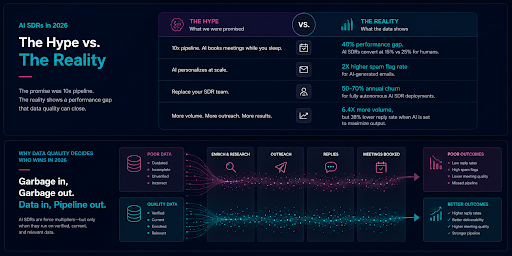
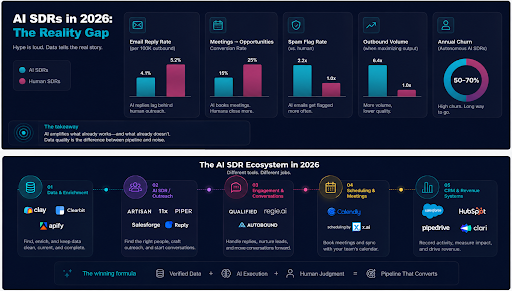
Here's the reality. Fewer than 40% of sellers report that AI has actually improved their productivity. AI SDRs convert meetings to opportunities at 15% versus 25% for human SDRs, a 40% performance gap according to SuperAGI benchmarks.
AI-generated emails get flagged as spam at more than double the human rate. And annual churn for fully autonomous AI SDR deployments sits at 50-70%.
The gap between the pitch deck and the pipeline is real. But writing off AI SDRs entirely is the wrong lesson. The category isn't broken. It's just been mis-sold as replacement rather than augmentation.
The teams getting real results have figured out something the vendor slides won't tell you: AI SDRs are exactly as good as the data feeding them. Garbage data plus AI equals automated garbage at scale. Verified, current, correctly classified data plus AI is where the 2-3x gains actually show up.
What is an AI SDR?
An AI SDR is software that performs the outbound sales development job: pick accounts, find contacts, research them, draft outreach across email and sometimes LinkedIn, handle initial replies, and book meetings on a rep's calendar.
The category shipped as "autonomous rep replacement" and has been quietly repositioning toward "AI teammate" or "outbound copilot" as the autonomous version keeps failing.
There are three flavours worth distinguishing:
Fully autonomous AI SDRs
These AI SDRs outbound with minimal human input. Artisan's Ava, 11x's Alice, Piper by Qualified, AiSDR, and Jason AI (Reply.io) sit in this category. These are the tools sold with the "hire an AI rep" pitch.
Reality is that most successful deployments have a human closely supervising, editing, and intervening.
AI copilots
AI copilots augment human reps rather than replace them. Autobound, Salesforge, Regie.ai, and Clari Copilot draft emails, research accounts, and surface intent while a human sends the final message.
Reply rates and meeting quality tend to hold up better here because a human filters what actually goes out.
AI orchestration platforms
These AI platforms don't send outreach themselves. They stitch signals, data, and workflows so the rest of your stack (including AI SDR tools) can act.
Clay, Bardeen, Relevance AI, and Nooks are the main players. CRM-native agents from Salesforce (Agentforce) and HubSpot (Breeze) increasingly overlap with this category.
Understanding which flavour a vendor actually sells is half the battle. The other half is understanding what data feeds it.
The 2026 reality check (real numbers)
Every AI SDR pitch shows the same demo: a rep asks the AI to book five meetings, and the AI produces five meetings. That's not how it works at scale. Here's what the data across real deployments actually shows.
Baseline reply rates
Baseline reply rate before AI SDR adoption sits at a median 2.4% with 12 meetings per month across a 75-team dataset from AiSDR. Teams with a working outreach motion see 2-3x gains after adding an AI SDR. Teams without one don't.
This is the single most predictive finding in the category: AI amplifies what already works, and it amplifies what already doesn't.
Email performance
On email-level performance, an analysis of 100K outbound emails split by human vs AI-sent showed a 4.1% reply rate for AI against 5.2% for human. The gap looks manageable until you factor in what happens next.
AI-generated emails carry a statistical fingerprint that spam filters have been trained to spot, so they trip content filters at more than double the human rate. When AI is told to maximise output rather than quality, volume jumps roughly 6.4x while reply rate drops around 38%.
That combination (more volume, worse targeting, higher spam flag rate) is how AI SDR pilots quietly torch domain reputation across a quarter.
Meeting quality
Meeting quality is where the sharpest gap lives. AI SDRs convert booked meetings to opportunities at 15% versus 25% for human SDRs.
The meetings get booked; a smaller share of them turn into deals. Which means "meetings booked" is the wrong success metric, and any vendor pushing it should be pushed back on.
Lead nurturing
The bright spots are real too. AI SDR tools engaging inbound website visitors in real time convert 2.6x higher than form-and-wait workflows.
Signal-qualified leads generated by AI show 47% better conversion than traditional scoring. Meeting booking rates improve 30-40% when AI optimises messaging, send timing, and channel selection.
The pattern is clear: AI wins where it's paired with real signal and real data. It loses where it's asked to invent both.
The hype
Strip the marketing away, and the AI SDR pitch reduces to four claims:
"Replace your SDR team." The autonomous replacement story sold hard in 2024 and 2025. It's what raised the money. Post-hype, the vendors quietly walking back that claim now position their tools as "augment," "copilot," or "AI teammate."
"Personalise at scale." The claim is that AI can research each prospect and write bespoke outreach. In practice, the "personalisation" is often surface-deep: a company name mention, an industry reference, a rehash of the prospect's LinkedIn headline. Real personalisation depends on context the AI doesn't have unless you feed it.
"24/7 pipeline generation." True in theory. The systems do run around the clock. The catch is that outbound at 3am doesn't perform meaningfully better than outbound at 3pm, and running volume overnight without oversight is how deliverability catastrophes happen.
"10x cheaper than headcount." True on the licence line item. Often untrue once you factor in the human hours required to set up, supervise, tune, and clean up after the AI. And genuinely untrue once you factor in the deliverability, brand, and TAM burn cost of an unsupervised AI SDR running badly.
None of this makes AI SDRs worthless. It means the honest sales pitch is smaller: "AI SDRs speed up the tedious parts of outbound if you give them good data and adult supervision." That version is defensible. The bigger version isn't.
The gap
The gap between the pitch and the performance concentrates around four failure modes.
1. Data quality is where most AI SDR pilots die
Every AI SDR tool sits on top of contact and firmographic data, either bought in or sourced from providers like Apollo, ZoomInfo, Cognism, Clearbit, or similar.
If that data has a 15-35% bounce rate (which real-world testing consistently shows for the largest providers), AI at scale amplifies the problem into a domain reputation crisis.
Higher volume plus stale data equals more bounces, more spam flags, and a sender score that takes months to recover. This is why the data layer under the AI matters more than the AI itself, and why teams treating enrichment as an ongoing discipline outperform teams that don't.
2. Personalisation collapses without deep context
An AI given "the company sells B2B SaaS to marketing teams in Europe" can only produce generic outreach. An AI given "the company is a Shopify Plus merchant doing over £5M GMV, using Klarna for BNPL, shipping internationally via DHL, running HubSpot Enterprise for marketing" can produce much better outreach.
The gap between those two prompts is the data layer, and it's exactly the technographic depth that transforms AI SDR output from generic to specific.
This is exactly where TAMI's data model was built to plug in. The platform surfaces the specific stack signals AI SDRs need to write with real context:
- ecommerce platform
- payment providers
- BNPL
- shipping methods
- martech stack
- banking
- hosting
All data is refreshed in real time and paired with verified contacts. Instead of feeding your AI SDR a firmographic sketch and hoping the model fills in the blanks, you're feeding it the actual merchant profile. The output stops sounding like AI trying to guess and starts sounding like a rep who read the site before writing.
3. Signal collapse is the third failure mode
AI SDRs work best when they act on real buying signals: job changes, funding events, tech installs, intent surges, website visits.
Without a live signal layer, they default to spraying the ICP list, which is exactly the failure mode buying an AI SDR was supposed to solve. Our guide to signal-based selling and the tools worth using covers where those signals should come from.
4. Deliverability collapse seals the deal
Google and Yahoo tightened bulk sender rules in 2024, and the enforcement has hardened since.
Bounce rates over 2% or spam complaints over 0.3% trigger blocks. AI SDRs running at high volume against stale lists cross those thresholds fast, which is why so many pilots produce great first-month numbers before quietly dying in month three.
Each of these four failure modes traces back to the same root cause: the data layer underneath the AI. Better AI models don't fix bad data. They just fail more efficiently.
Where data still wins (and why TAMI is built for exactly this)
The teams whose AI SDR deployments are producing 2-3x gains share four data-layer characteristics. This is what separates the wins from the wasted spend.
Verified emails with sub-5% bounce rates
AI at scale multiplies whatever your bounce rate is. Running an AI SDR on a list with 15-35% bounces means every send session is a small deliverability crisis.
TAMI keeps bounce rates under 5% with contact data verified and refreshed in real time. At AI SDR volume, that’s the difference between a domain that lands and a domain that gets blocked.
Real-time refresh, not quarterly crawls
Job changes, role shifts, and company changes happen constantly. An AI SDR working from a database refreshed once a quarter is personalising to people who left three months ago. TAMI's real-time refresh means the AI is writing to the person actually holding the role today, which is the entire prerequisite for personalisation to work.
AI-based classification
Standard industry codes were designed for a pre-internet economy and don't accurately describe modern ecommerce, fintech, or SaaS businesses. Feeding an AI SDR with those codes produces generic outreach because the AI doesn't actually know what the business does.
TAMI's AI classification reads the actual signals (products, tech stack, payment providers, shipping, geography) to produce a categorisation the AI can genuinely use.
This is what makes filters like "vegan skincare brands doing over £2M in the UK using Klarna and shipping internationally" possible instead of aspirational. ICP profiling built on this level of classification always outperforms demographic guesswork.
Deep technographic and merchant intelligence
AI SDRs producing genuinely personalised outreach need context beyond firmographics. The more accurate context you feed the AI, the less generic its output.
TAMI holds a European patent for ecommerce merchant detection specifically because that identification depth is what makes commerce-adjacent AI SDR motions work at all. Without it, an AI SDR targeting merchants defaults to generic B2B outreach that treats every store the same.
These four characteristics compound.
- Verified contacts prevent domain damage.
- Real-time refresh keeps personalisation relevant.
- AI classification makes filters and messaging accurate.
- Deep technographic data makes outreach specific rather than surface-level.
A UK martech team comparing TAMI against Apollo, ZoomInfo, and Cognism as the data layer feeding their outbound saw a 10x higher inbound conversion rate and a 95% email delivery rate. That's the delta between an AI SDR that produces pipeline and one that produces churn.
The uncomfortable truth for anyone buying an AI SDR right now is that the AI is easier to swap than the data. If your pilot fails, changing vendors from Artisan to 11x or from Piper to AiSDR won't fix it. Fixing the data layer will.
The AI SDR deployment playbook that actually works
Based on the data across 75+ real deployments, here's what the pattern looks like when AI SDRs actually work.
Step 1: Fix the data layer first
Before you buy an AI SDR, audit your bounce rate, contact accuracy, and classification depth. If any of the three is broken, fix it before adding AI to the stack.
This is the highest-leverage step and the one most teams skip. Our CRM data enrichment solution breakdown covers what "fixed" actually looks like.
Step 2: Start with a copilot, not an autonomous agent
The performance data is unambiguous. Copilots outperform autonomous deployments because the human catches obvious misses before they burn TAM. Once your motion is working with a copilot, autonomous mode is a step you can consider. Not before.
Step 3: Feed the AI real signals, not just an ICP list
An AI SDR spraying your ICP is the failure mode you were trying to escape. An AI SDR triggered by job changes, funding events, tech installs, and intent surges is genuinely different. Signal-based deployment is where the 2-3x gains actually show up.
Step 4: Measure the right thing
Meetings booked is the wrong success metric. Meeting-to-opportunity conversion is the right one, because AI SDRs book meetings that don't convert at a much higher rate than humans do. Track quality, not just quantity.
Step 5: Monitor deliverability weekly, not monthly
AI SDR volume moves fast enough that a sender-score crisis can happen inside a fortnight. Weekly monitoring catches it. Monthly monitoring watches the damage compound.
Step 6: Keep human oversight through the reply layer
AI handles the outreach reasonably well. AI handles the first-reply layer terribly, because that's where nuance, judgement, and relationship context matter. Route replies to humans by default until the AI has earned autonomy through track record.
Final thoughts
AI SDRs are the most overpromised category in sales tech and one of the most useful when deployed correctly. The autonomous replacement story is dying , and the copilot-plus-strong-data story is winning. The variable that decides which side of that split a team lands on isn't the model. It's the data feeding the model.
If you're evaluating an AI SDR pilot in 2026, the highest-ROI move you can make is fixing the data layer before you touch the AI layer.
Create a free account with TAMI and see what a data layer built for AI-scale outbound actually looks like, before you spend another quarter blaming the model for a problem the data was quietly creating all along.
Frequently asked questions
Are AI SDRs actually worth using in 2026?
Yes, in copilot mode with a strong data layer and clear signal sources. The 2-3x gains reported across benchmarks come from teams that already had working outreach and added AI to amplify it. AI SDRs are not worth using as autonomous rep replacements, where annual churn sits at 50-70%.
Why do AI SDRs have such high spam flag rates?
AI-generated text carries a statistical fingerprint that modern spam filters have been trained to detect. Combined with high volume against stale or inaccurate contact data, this produces spam flag rates at more than double the human baseline.
What's the biggest reason AI SDR pilots fail?
Data quality. Every 2026 benchmark points to the same conclusion: AI amplifies whatever's underneath it. Teams with working outbound and clean data see 2-3x gains. Teams with broken outbound or dirty data see faster failure. The AI is rarely the variable that decides success.
Should I replace my SDR team with an AI SDR?
No. The performance data across 2025-2026 is unambiguous: hybrid models where AI handles operational load and humans handle qualifying conversations outperform autonomous deployments across every metric that matters (reply quality, meeting-to-opportunity conversion, and account preservation).
Which AI SDR platform is best?
The wrong question. The right question is which data layer is best, because it decides the outcome across every platform. Once your data layer is verified, current, and correctly classified, the AI SDR choice becomes a secondary decision about workflow fit and integration depth.