What Is Technographic Data? The B2B Targeting Playbook
07/07/2026
Signal-Based Selling: 10 Tools for Outbound That Converts
27/07/2026
Apollo.io scores 4.7 out of 5 on G2, and 2.9 on Trustpilot. That gap is the whole story. G2 tends to attract active users happy with what they're getting. Trustpilot tends to attract disputes, account suspensions, and data quality complaints. Both are real. And both explain why "Apollo.io alternatives" is one of the most searched B2B tool queries of 2026.
We pulled the recurring complaints from G2, Trustpilot, and Reddit across the last twelve months, then built this list around the alternatives that solve the specific problems users flag most often.
Each tool has real strengths and real weaknesses, and the right pick depends entirely on what's actually broken for you. If it's bounce rates, some of these are dramatically better. If it's European data, others own that segment. If it's ecommerce or merchant targeting, the answer is different again.
Why users leave Apollo.io (per their own reviews)
Before the list, it's worth being specific about what's driving the churn. The pattern across review platforms is remarkably consistent:
- Bounce rates in the 15-35% range despite Apollo's verification badge, with heavier degradation above 10,000 contacts per month. This is the single most cited complaint on G2 and Reddit.
- Credits running out mid-campaign, particularly on Basic and Professional tiers, with a 60% price jump between Basic and Professional flagged as unwelcome.
- Weak European and mobile data outside the US, with Reddit threads full of teams switching for EMEA prospecting specifically.
- Slow customer support, which is Apollo's lowest-rated G2 sub-category at 4.2 out of 5, and the driver of most Trustpilot complaints.
- The January 2026 removal of automated LinkedIn actions, which broke outbound workflows that combined Apollo's email with LinkedIn touches. Connection requests, messages, and profile views now have to be completed manually.
Those are the complaints. Below is what to swap in.
Quick comparison of the 8 best Apollo.io alternatives
Here are the top-rated Apollo.io alternatives in 2026:
|
Tool |
Best for |
Standout feature |
Starting price |
Common complaint |
|
Cognism |
EMEA outbound, cold calling Europe |
Diamond Data phone verification, 15-country DNC screening |
~$15K/yr |
Opaque pricing, Diamond Data often extra |
|
ZoomInfo |
US enterprise, all-in-one GTM |
Largest US database, Chorus, Copilot |
~$15K/yr |
Stale contact records, opaque pricing |
|
TAMI |
Ecommerce, merchant, and cross-border targeting |
Real-time merchant detection, sub-5% bounce, AI classification |
Custom |
Specialised (not a general B2B DB) |
|
Lusha |
Solo reps, small teams, LinkedIn prospecting |
Free tier, clean Chrome extension |
Free-$$$ |
Limited depth, US-heavy |
|
UpLead |
Mid-market, verified emails |
95% guaranteed email accuracy, credit-back on invalid |
$99/mo |
Smaller database than enterprise tools |
|
Lead411 |
Growth-signal targeting, intent |
Triple-verified email data, Bombora intent included |
Custom |
Dated UI, basic native outreach |
|
Seamless.AI |
Teams wanting unlimited-search framing |
Free plan, AI-generated contact info |
Custom |
Data accuracy inconsistent, bounces |
|
LeadIQ |
Sales prospecting workflow inside SFDC |
Deep Salesforce integration, sequence-ready |
~$75/user/mo |
Smaller database, credit-based limits |
What to look for in an Apollo.io alternative
Before jumping to individual tools, four criteria decide most of the outcome. Get these right and any of the alternatives below become defensible choices. Get them wrong, and you'll be running the same problems on a different logo.
The first is email accuracy at your actual send volume. Every tool markets 95%+. Almost none of them holds that at 10,000+ sends per month. Ask for bounce-rate benchmarks specific to your target geography and industry, not aggregate marketing numbers.
The second is geographic and stack depth for your ICP. A tool with 500M contacts is meaningless if only 20M of them sit in your actual TAM. Cognism dominates EMEA. ZoomInfo dominates the US mid-market and enterprise. TAMI dominates ecommerce and merchant intelligence globally. Match the tool to where your buyers actually live.
The third is data freshness. Most vendors refresh on a rolling but slow cycle, which means the "verified" contact you email today may have changed roles months ago. Real-time refresh is the difference between a list that keeps working and one that decays quietly across a quarter.
The fourth is workflow fit. If your team lives in Salesforce, prioritise the tool with the tightest SFDC integration. If your motion is LinkedIn-heavy, prioritise Chrome extension reliability, especially now that Apollo's LinkedIn automation is gone.
For a fuller view on the underlying data question, our breakdown of B2B data enrichment for sales teams covers what "good" actually looks like operationally.
1. Cognism
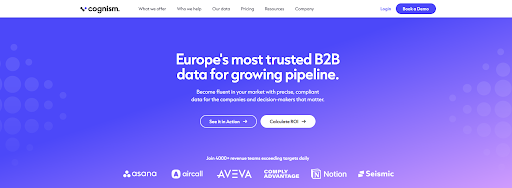
Best for: Teams selling into Europe, cold calling EMEA, or needing GDPR-baked-in compliance.
Overview: Founded in London, Cognism was designed with GDPR at its core rather than bolted on. Diamond Data (phone-verified mobile numbers) is the headline feature, produced by human researchers physically calling numbers and confirming the contact answers.
Key features:
- Diamond Data phone-verified mobiles with a reported 20% connection rate into EMEA
- DNC screening across 15 registries including UK TPS/CTPS, Germany, France, Spain, Sweden, Italy
- Sales Companion AI for enrichment inside your CRM
- Integrations with Salesforce, HubSpot, Outreach, Salesloft
Pricing: Custom-quoted, typically starting around $15,000-$25,000 per year. Diamond Data access often carries a premium on top of base.
What reviewers say (positive): "Data accuracy between 80-90%" for both emails and mobiles is the most-cited strength, along with the intent data on higher tiers.
What reviewers say (critical): Lack of transparent pricing frustrates smaller buyers. Several reviewers acknowledge that "despite the sales pitch, their data is not flawless" and note occasional outdated information, though they concede this is common across all providers.
Verdict: The strongest all-around alternative for teams whose primary pain is Apollo's weak EMEA data or GDPR risk. If you're weighing Cognism against ZoomInfo specifically, our full Cognism vs ZoomInfo comparison breaks down where each one wins.
2. ZoomInfo Sales
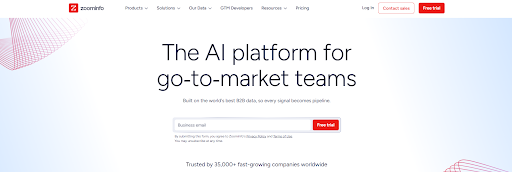
Best for: US enterprise sales orgs wanting an all-in-one GTM platform.
Overview: ZoomInfo is the largest B2B data provider in North America, packaged as a multi-product suite (SalesOS, MarketingOS, OperationsOS). If Apollo felt too lightweight for a large sales team, ZoomInfo is the direction most teams go.
Key features:
- 500M+ contacts, 100M+ companies, 135M+ verified phone numbers
- Chorus conversation intelligence, Copilot AI, intent signals built in
- Integrations with Salesforce, HubSpot, Outreach, Salesloft, and 50+ other tools
Pricing: Custom-quoted. Third-party procurement data puts the entry point around $15,000 per year for a single seat on the base plan. Intent data, org charts, and advanced features are gated behind higher tiers.
What reviewers say (positive): Prospecting workflow, account management structure, and data breadth are regularly praised compared to less organised alternatives.
What reviewers say (critical): Stale contact records are the most common complaint, with reviewers citing calls to contacts who left companies years ago. Data accuracy gaps show up repeatedly for smaller companies and fast-moving roles.
Verdict: The safe enterprise pick if you sell into the US and can absorb the price. Overkill and overpriced for small teams.
3. TAMI
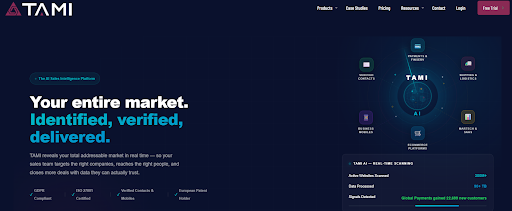
Best for: Teams targeting ecommerce, merchant, payments, logistics, or cross-border commerce accounts.
Overview: TAMI is the specialist choice on this list, and worth including because most Apollo users targeting commerce ecosystems don't realise a purpose-built alternative exists. Where the others index all B2B companies broadly, TAMI's data model was built around identifying merchants accurately.
That includes their size, category, payment stack, shipping methods, and BNPL adoption. The platform holds a European patent for ecommerce merchant detection specifically because that identification problem is what most generic data tools quietly skip.
Key features:
- Real-time refresh so contact and stack data reflects what's true today
- AI-based classification replacing SIC and NAICS codes
- Deep merchant intelligence including payment providers, shipping carriers, ecommerce platforms, BNPL, and merchant traffic tiers
- Verified emails with sub-5% bounce rates (compared to Apollo's reported 15-35%)
- Cross-border commerce intelligence for teams selling into international merchants
- CRM integrations with Salesforce, HubSpot, Pipedrive, Close.io, Mailchimp
Pricing: Custom-quoted, positioned for teams whose motion is commerce-adjacent rather than general B2B.
What users say (positive): In direct comparisons against Apollo, ZoomInfo, and Cognism, a UK martech team reported a 10x higher inbound conversion rate alongside a 95% email delivery rate on TAMI's data. The bounce rate delta shows up as the most consistent user-cited difference.
What users say (critical): TAMI is not the right pick if you sell into every industry. It's a specialist platform, deliberately deeper on commerce and cross-border.
Verdict: The specialist pick when Apollo's real problem for you is either bounce rates or the fact that generic B2B databases don't understand ecommerce, merchant, or cross-border targeting.
4. Lusha
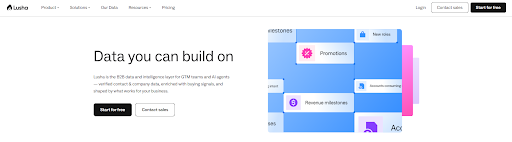
Best for: Solo reps, small teams, and LinkedIn-first prospecting workflows.
Overview: Lusha built its reputation on a clean Chrome extension and a genuinely usable free tier. It's the closest thing to a "just works" tool in this list.
Key features:
- 70 free credits per month on the free plan
- Chrome extension for LinkedIn and company sites
- Direct dials with reportedly higher accuracy than Apollo on the same segments (per 2026 G2 reviews)
Pricing: Free tier available. Paid tiers scale by seat and credit volume.
What reviewers say (positive): Ease of use and speed of getting a contact are the biggest strengths. The free tier gets a lot of goodwill.
What reviewers say (critical): Coverage depth outside the US is limited, and the credit model can feel restrictive at scale.
Verdict: If Apollo's complexity or price is the problem more than its data, Lusha is the simplest swap. Not the choice for enterprise motions.
5. UpLead
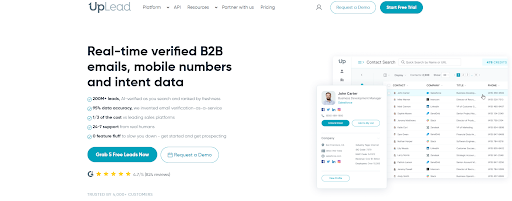
Best for: Mid-market teams whose primary pain is email accuracy.
Overview: UpLead differentiates on verified emails with a guaranteed 95% accuracy rate and credits refunded for invalid contacts. That's the pitch, and the reviews mostly back it up.
Key features:
- 95% email accuracy guarantee with credit-back policy on invalid contacts
- Real-time email verification at export
- Technographics and firmographics for filtering
Pricing: Plans start at $99 per month for Essentials, scaling up from there.
What reviewers say (positive): Consistently praised for actually holding its accuracy claim in the real world, unlike vendors whose guarantees are theoretical.
What reviewers say (critical): Database is smaller than ZoomInfo or Cognism, so heavy TAM coverage isn't the play here.
Verdict: Strong choice if Apollo's bounce rates are the problem and you don't need enterprise scale. Fair pricing for what you get.
6. Lead411
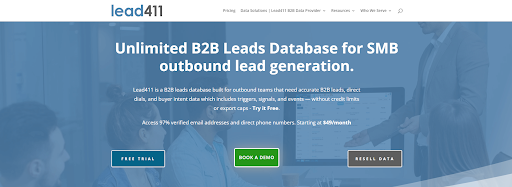
Best for: Teams targeting growth signals (hiring, funding, tech installs) alongside contact data.
Overview: Lead411 built its differentiation around triple-verified email data (SMTP, human, email open validation) and included Bombora intent data on higher plans. It's a lesser-known name that punches above its weight on accuracy.
Key features:
- Triple-verified email data
- Bombora-powered intent data on higher tiers
- Growth signals including hiring, funding, expansion, tech installs
- Truly unlimited exports on Enterprise plans (no credit anxiety)
Pricing: Custom-quoted, though widely reported as more affordable than ZoomInfo for equivalent functionality.
What reviewers say (positive): Data accuracy is the recurring reason reviewers stay. Unlimited exports on Enterprise remove a specific pain point Apollo users report.
What reviewers say (critical): UI feels a generation behind Apollo, Instantly, or Saleshandy. Built-in outreach tool (Reach) is basic.
Verdict: Underrated. If you want accuracy plus growth signals and don't care about a polished UI, this is the sleeper pick.
7. Seamless.AI

Best for: Teams that liked Apollo's Basic-tier "unlimited search" framing.
Overview: Seamless.AII markets itself on unlimited searches and a usable free plan. The workflow feels close to Apollo's, which lowers the switching cost, though data quality is a real question mark.
Key features:
- Unlimited search framing (subject to fair-use)
- Free plan usable enough to test on your ICP before paying
- AI-generated contact info
Pricing: Opaque. Most tiers require a sales quote, and the free plan doesn't give great visibility into paid tier costs.
What reviewers say (positive): Onboarding is fast, closer to Lusha's simplicity than ZoomInfo's complexity.
What reviewers say (critical): Data accuracy is the recurring complaint, with bounced "verified" emails and stale mobiles showing up in critical reviews often enough to matter.
Verdict: Fine if you're leaving Apollo for the workflow. Not the fix if you're leaving because of data quality.
8. LeadIQ
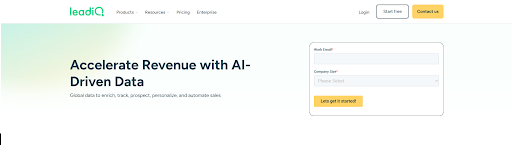
Best for: Reps living inside Salesforce with a defined prospecting workflow.
Overview: LeadIQ is prospecting-workflow-first rather than database-first. If your reps' day is "find contact, enrich in SFDC, drop into sequence," LeadIQ was built for that motion.
Key features:
- Deep Salesforce and HubSpot integration
- Prospecting workflow with sequence-ready enrichment
- Chrome extension optimised for LinkedIn Sales Navigator
Pricing: Around $75 per user per month for the Pro plan, scaling from there.
What reviewers say (positive): Workflow speed and integration depth are the standouts. Reviewers report meaningful time savings versus copy-pasting from Apollo.
What reviewers say (critical): Database is smaller than the big three, and credit-based limits pinch at scale.
Verdict: Best pick if workflow speed matters more than raw database size.
How to choose (a short decision framework)
Cut through the noise with four questions. Answer them honestly and the right tool becomes obvious.
"Is my primary pain Apollo's bounce rate?" UpLead, Lead411, or TAMI (in that order for general vs mid-market vs commerce use cases). Each has meaningfully lower reported bounce rates and is willing to stake pricing or verification guarantees on it.
"Do I sell primarily into Europe?" Cognism, hands down. The DNC screening breadth and Diamond Data mobiles aren't matched by anyone else on this list.
"Do I sell primarily into US enterprise?" ZoomInfo, if the budget stretches. Its US mid-market and enterprise coverage remains the deepest in the category.
"Is my ICP commerce-adjacent (ecommerce, payments, logistics, cross-border)?" TAMI. This is one of the few genuine data category gaps in the market, and generic tools don't cover it well. Our breakdown of how ideal customer profiling uses this level of stack depth walks through what changes when your filters actually match your buyers.
For teams whose issue is less "which tool" and more "our entire outreach engine leaks," the alternative to swapping vendors is fixing the pipeline. Our guide to email campaign optimisation covers where the biggest deliverability leaks sit, most of which no data tool fixes on its own.
Final thoughts
The best Apollo.io alternative is the one that solves your specific pain, not the one with the biggest brand. Cognism owns Europe. ZoomInfo owns US enterprise. Lusha owns simplicity. UpLead owns email accuracy at mid-market scale. Lead411 owns growth signals. LeadIQ owns SFDC-first workflows. And TAMI owns ecommerce, merchant, and cross-border intelligence.
Apollo owns the mid-tier default, and it'll keep owning it until enough of its users decide the bounce rate is costing them more than the switch would.
If you're moving off Apollo because the data is broken for commerce-focused prospecting, or because 15-35% of your sends are hitting nothing, book a demo of TAMI. You’ll see what real-time merchant intelligence, AI classification, and sub-5% bounce rates look like against the ICP you're already trying to reach.
Frequently asked questions
Is Apollo.io still worth using in 2026?
Yes for solo reps and small teams doing US-focused prospecting where budget is the main constraint. The 4.7 G2 score is real. But at scale (10,000+ sends per month, EU coverage, or enterprise workflows), the recurring complaints about bounce rates and support push most teams to look at alternatives.
Which Apollo.io alternative has the lowest bounce rate?
Based on public user-reported figures, TAMI (sub-5%), UpLead (95% guaranteed), and Cognism (~85-90% delivery) are the most-cited on bounce-rate reliability. Apollo's real-world bounce rate sits in the 15-35% range according to G2 reviews.
What's the cheapest Apollo.io alternative?
Lusha's free tier is the cleanest low-cost entry. UpLead's $99 per month plan is the cheapest paid option with a meaningful accuracy guarantee. TAMI isn't the cheapest by sticker, but with sub-5% bounce rates and 10x higher inbound conversion in head-to-head tests, it's usually the cheapest per closed deal.
Which Apollo.io alternative is best for EMEA?
Cognism, without much argument. Its GDPR-first design, 15-country DNC screening, and Diamond Data phone verification for EU mobiles are category-leading.
Which alternative works best for ecommerce or merchant prospecting?
TAMI. It's the only tool on this list built specifically around merchant detection, payment stack data, ecommerce platform identification, and cross-border commerce intelligence.