MCP infrastructure for B2B AI applications is what turns a capable assistant into something your revenue team can actually sell with. It works by connecting Claude, ChatGPT, or your own agent to a live data source through the Model Context Protocol.
Most people arrive at this looking for something they cannot name. They know they want their AI tool to find companies, verify emails, and tell them what technology a prospect runs. They do not know that this category now has a standard, a protocol, and a growing set of servers to connect to.
What are you actually searching for?
The naming problem is worth clearing up first, because it sends people to the wrong products. Most teams evaluating this describe it in the language of the tool they already have open, so here is the translation.
If you have searched for a way to connect Claude to a company database, or for a ChatGPT plugin that finds leads, you are looking for an MCP server that carries B2B data.
If you have searched for AI that can find leads for you, what you need is company search and contact enrichment exposed as tools the assistant can call.
If you have searched for how to stop ChatGPT inventing email addresses, the answer is grounding, and that is the whole purpose of this layer.
Engineers tend to call the same thing AI agent infrastructure, meaning the client, the server, the authenticated connection, and the metering that sits behind them. And if you have been comparing B2B data API options, that is the sibling product: identical data, consumed by your code rather than by a chat.
All of those searches lead to the same place. The Model Context Protocol is the open standard underneath it, introduced by Anthropic in November 2024 and now supported across the major assistant platforms, which is why a single connector works in several tools instead of needing to be rebuilt for each one.
What can an MCP-connected B2B data application do?
Knowing what the category is called only helps if you know what to expect from the products inside it. TAMI AI is one of them, so the rest of this guide works through the TAMI AI MCP server tool. Every capability below runs against TAMI AI's own index of 71 million companies, built from 402 million crawled websites, and they appear in the order teams reach for them.
So, here’s what you can do with TAMI’s MCP infrastructure:
1. Search companies in plain English
You describe the market in a sentence, and TAMI AI returns the companies that match it.
Country, sector, turnover band, employee count, and technology in use can all sit inside the same request. And because the assistant holds the result set in context, your second and third questions narrow the list rather than starting a fresh search.
Nobody knows the right filter combination before they start looking, which is exactly why a conversation works better here than a menu.
2. Find and enrich contacts
Once the company list looks right, you ask for the people inside it. TAMI AI returns named contacts by role and seniority, then supplies verified email addresses and mobile numbers on request.
Rows that fail to match are not charged, which matters more here than anywhere else, since contact lookups are where an assistant burns through requests fastest.
TAMI AI reports match rates of 96% or better on companies and 80% or better on contacts, and publishes the two figures separately rather than blending them into one.
3. Match on the identifier you already hold
Most contact enrichment starts from a single field.
You give TAMI AI a website or a company name, and it returns the full record with up to 135 fields covering industry, headquarters, headcount, and revenue.
A half-finished export becomes something a rep can work from in one step, and you avoid the usual problem of needing a shared key between two systems before anything will reconcile.
4. Detect carriers, processors and platforms
TAMI AI reads a company's live website to identify the shipping providers, payment processors and ecommerce platforms it runs, using detection covered by a European patent.
No registry holds that information and companies do not publish it in any structured form, so it is the layer of intelligence most prospect lists simply do not carry. It also changes the questions you can ask.
“Which retailers ship with DPD and turn over more than £10 million” becomes a single request rather than a research project.
5. Pull company news and activity
TAMI AI also returns recent news and LinkedIn activity for the companies you are working on.
A rep can then open on something the business did last month instead of a general observation about its sector.
For example, a list of forty accounts effectively sorts itself once you can see which of them have just raised money, entered a new market, or started hiring.
6. Hand the result off to the stack you already run
Findings have to leave the conversation to be worth anything.
You can import a CSV for TAMI AI to enrich, export the completed file, or send records straight into the CRM. In that instance, TAMI AI acts as the data layer while your own systems remain the system of record. That’s exactly the division that stops a chat window quietly becoming a second database.
Records arrive deduplicated, so what you already hold gets updated rather than copied. TAMI AI applies GDPR consent and suppression rules per country as records pass through, so nothing enters the CRM that you cannot use in the market it came from.
7. Build on the API when a chat is the wrong interface
Some work should never run through a conversation at all.
Scheduled enrichment jobs, form-fill lookups, and in-product company matching belong in your own code, and TAMI AI can help with that too. Through the B2B data API, it can serve the same company, contact, and detection data, metered against the same credit wallet as MCP usage.
The rule of thumb is straightforward. If the answer lands in a conversation or a document, use MCP. If it lands in a database or an interface, use the API, and expect the same considerations that apply to any data integration tools.
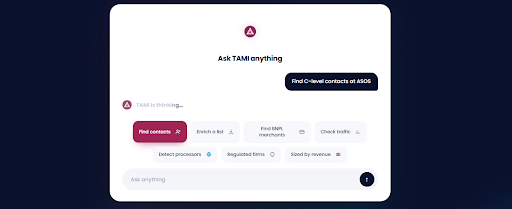
Seven prompts worth trying in the first session
Reading about this is less useful than testing it, so here are seven requests that each exercise a different tool. Type them the way you would say them to a colleague.
- Fintechs in Germany using Stripe, with headcount and revenue.
- Enrich these ten contacts with verified emails and mobile numbers.
- UK merchants offering buy now, pay later at checkout.
- Everything you hold on this domain, all fields.
- Which payment processor does this merchant use, and who ships their orders.
- Retailers turning over more than £10 million that ship with a named carrier.
- Recent news for these twelve accounts, so I know who to call first.
Run the fourth one against a company you already know well. Checking a record you can verify yourself tells you more about how far to trust the rest than any published accuracy figure will.
How is this different from a contact database with a connector?
Several data vendors now ship an MCP connector, so the comparison deserves a direct answer. Contact coverage is table stakes, and on that measure the market is broadly comparable. Three things separate the options once you look past it.
Detection
Knowing which processor, carrier, and platform a company runs supports segments that firmographic filters cannot express at all. That intelligence has to be read from the live web rather than bought from a register.
Classification
TAMI AI classifies companies using AI applied to live web signals instead of registered SIC codes. That matters a lot because a registered code rarely describes what a company actually sells, which is especially important in software and payments markets.
Metering
TAMI AI spends credits only when a lookup returns a result, with no separate MCP subscription layered on top.
Treat that as an architectural requirement rather than a pricing detail. An assistant given one instruction will fan out into dozens of speculative lookups, many of which find nothing. Paying per request instead of per result forces teams to restrict the agent until it stops being useful, which won’t ever be the case with TAMI AI.
What should you check before you commit?
Any vendor can publish a connector, and the ones worth keeping are obvious from a handful of questions. Before you decide to commit to MCP infrastructure for B2B AI applications, ask the following:
- Are match rates given separately for companies and contacts, or blended into a single flattering number?
- Does the server return signals the model could not otherwise reach (such as detected technology), or only firmographics you already hold?
- Are credits charged on results or on requests?
- Does every call resolve to a named user carrying that user's entitlements?
- Is there a clean route from the conversation into the CRM, so findings do not stall in a chat window?
- Can compliance settings be configured market by market?
In most companies, the answers to these end up mattering to RevOps teams, who inherit both the connector and the quality of everything that comes through it.
Start with a question you already know the answer to
This category is new enough that most people evaluating it are still guessing at the vocabulary, which makes it easy to buy the wrong thing.
What you need is a server that grounds the assistant in real company data, returns signals the model cannot infer, respects your account permissions, and bills you only when it finds something. Everything above that is interface.
Test it against a market you know well. Get early access to the TAMI AI MCP server and ask your first question today.