
A company data API that searches, not just enriches
Most company data APIs take a domain and hand back a record. That works when you already know the company. TAMI AI takes filters and hands back the companies, so you can query a market rather than look one up.
Send a query for UK merchants on a given platform running a specific payment provider and get structured records back: firmographics, full technology stack, payments, carriers, trading status and verified contacts in the same response.
71m company records. 458m contacts. One API.
No card needed. Test a query before you write any integration code.
Enrichment answers a question. Search finds the question.
An enrichment endpoint needs an input you already have. A search endpoint needs criteria. If your product has to discover companies rather than describe them, only one of those is any use.

What is a company data API?
A company data API delivers structured business information to your application on request, rather than through a file or a platform interface. It typically returns firmographics such as name, domain, size, revenue and location, and better ones add technology, financial and contact fields.
There are two kinds. An enrichment API takes something you already hold, usually a domain, and returns a fuller record. A search API takes filters and returns the companies matching them. Most providers offer only the first.
Why company data integrations disappoint
Three failures, and none of them appear in a coverage claim.
You pay for the misses
Credit models often charge per call regardless of whether anything came back. A high miss rate on your specific segment quietly doubles the real cost per usable record.
The response shape changes
Fields appear, disappear and get renamed without warning, and your parsing breaks in production rather than in staging.
Lookup only, no search
Plenty of APIs enrich a known domain and cannot return a list. If your product needs discovery, that limitation surfaces after integration..
Judge an API on the response, not the brochure. TAMI AI supports search as well as enrichment, keeps the schema stable, and does not charge for empty results.
THE FIELDS IN THE RESPONSE ARE THE PRODUCT
Every provider claims coverage. Far fewer will show you a full response body before you sign.
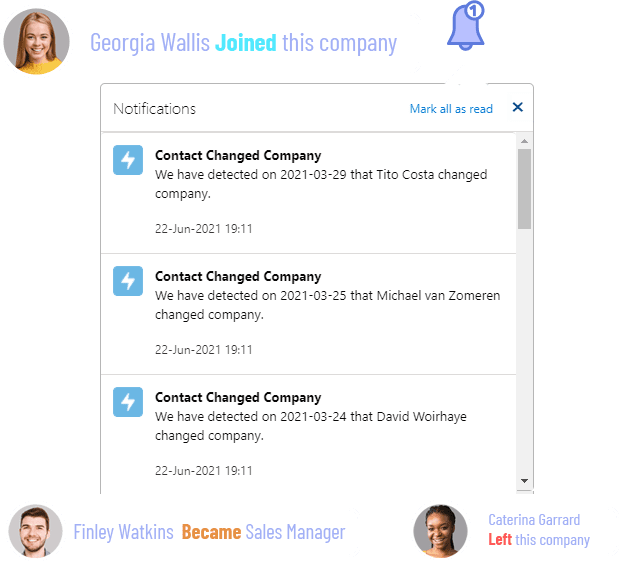
The commercial fields are the ones you cannot assemble elsewhere. Payments, checkout and carrier detection come from our European patent, and arrive in the same response rather than from a second vendor.
Run a query against the free tier and read the actual response. No integration needed.
WHAT OUR CLIENTS THINK OF TAMI AI





What the API returns, by use case
Six ways our customers query the API, and the fields that matter in each.
-
Payments and fintech
Processor, payment methods, currencies and BNPL per merchant.
Explore payments → -
eCommerce
Platform, checkout stack and verified trading status.
Explore eCommerce → -
SaaS and tech
Full technology stack, including hosting and martech.
Explore SaaS → -
Logistics
Carrier relationships and destination corridors.
Explore logistics → -
Manufacturing
Systems in use, from trade portals through to ERP.
Explore manufacturing → -
Retail
Currencies, storefront count and international footprint.
Explore retail →
Our European patent for merchant detection is why payments, checkout and carrier fields exist in the response at all. No general-purpose company data API returns them.
Three questions to ask before you integrate
One
Can I search by filter, or only look up a domain I already have?
Two
Do I get charged when a call returns nothing?
Three
What is your policy when a field is added, renamed or removed?
Not a coverage claim. A response you can read.
Every answer is testable on the free tier before you write integration code.
What comes back in a response
These are the fields that decide whether the integration was worth building.
Company identity and firmographics
Name, domain, sector, size band, revenue band, region and city.
Full technology stack
Platform, CMS, martech, analytics, hosting and banking provider.
Payments and checkout
Processors, payment methods, currencies and BNPL adoption.
Shipping and carriers
Carriers used and destination markets served.
Merchant and trading status
Whether the business genuinely trades online, verified rather than inferred.
Contact records
Verified emails, direct dials, job titles and seniority from the same API.
Every field is filterable as well as returnable, so the same attributes you read in a response can be used as search criteria.
WE BUILD THE DATA, SO WE CAN SEARCH IT
Providers that licence data from elsewhere can usually only look it up. TAMI AI reads company websites directly and classifies each business with AI, which is why every attribute in the response also works as a query parameter. If you need enrichment against records you already hold, our data enrichment API covers that case specifically.

458M+
CONTACTS


REAL TIME
REFRESH


What you get with API access
Beyond the endpoints themselves.
- Search and enrichment endpoints Query by filter or look up a known company, from the same key.
- A contact data API in the same integration People fields alongside company fields, without a second provider.
- Stable response schema Field changes are communicated rather than shipped silently.
- A free tier Test real queries against real data before committing.
- No charge for empty responses You pay for records returned, not calls attempted.
- Continuous refresh Records re-read from live sites, so the data does not age between imports.
Is API-delivered B2B data GDPR compliant?
It depends on the source and how you use it. Company-level fields are not personal data. Contact records are, so if you consume the contact data API you become a controller for those records and need a lawful basis, source transparency and suppression. TAMI AI sources directly rather than reselling, so provenance is documented for any record your DPO asks about.
How TAMI AI compares on company data APIs
Two platforms UK teams evaluate alongside us, and what each does best.
| People Data Labs | Coresignal | TAMI AI | |
|---|---|---|---|
| Search by filter | Yes | Yes | Yes |
| Company enrichment | Yes | Yes | Yes |
| Contact data in the same API | Yes | Yes | Yes |
| Technology stack fields | Partial | Partial | Full |
| Payments and BNPL fields | No | No | Patented |
| Carrier and corridor fields | No | No | Yes |
| Verified merchant status | No | No | Yes |
| UK depth published | No | No | 1.6m companies |
| Free tier | Yes | Trial | Yes |
How to evaluate a company data API, in six steps
Test against your actual segment
Global coverage figures tell you nothing about your niche. Run a hundred real queries from your own use case, which is what the free tier is for.
Measure the miss rate, then the cost
Cost per call is meaningless without a hit rate. Work out cost per usable record, and check whether empty responses are billable. Ours are not.
Read a full response body
Field names, nesting and null handling shape how much code you write. TAMI AI will show you a complete response for your use case rather than a field list.
Check whether search is supported
Enrichment against a known domain and search by filter are different capabilities. Every field TAMI AI returns also works as a query parameter.
Ask about schema changes
Find out how field additions and removals are communicated. Silent changes break production, not test suites, so we announce them rather than ship them.
Plan for refresh, not just retrieval
Data ages after the call. Because TAMI re-reads company sites continuously, you can requery on a schedule rather than accepting a stale snapshot.
An API is a dependency. Hit rate, response stability and failure behaviour matter more than any published coverage number.
WHAT TEAMS DO WITH IT
 Add company search to your own application
- Enrich signup forms from a domain
- Populate a warehouse for internal analysis
- Score accounts inside your own model
- Keep records current without manual imports
- Feed the CRM without an integration project
- Standardise company fields across systems
- Query the commercial stack alongside firmographics
- Pull contacts through the contact data API
- Rerun queries on a schedule as records change
Test the response before you write the integration. The free tier costs nothing.
FOR WHEN YOU NEED MORE THAN ONE RECORD AT A TIME
Some workloads are per-call. Others need a segment loaded into a warehouse and refreshed.
- Query by filter and take the full result set rather than iterating lookups, so analysis and modelling work from the same data as your application.
- Stripe, United States Postal Service, Trustpilot and DHL use TAMI's data across their systems.
NO CUSTOM DEVS. JUST PLUG IN
With TAMI AI, building a verified UK contact list takes minutes. Setup is instant. Data starts flowing straight away. Here's what TAMI AI integrates with:





QUALIFY A COMPANY WITHOUT LEAVING THE TAB
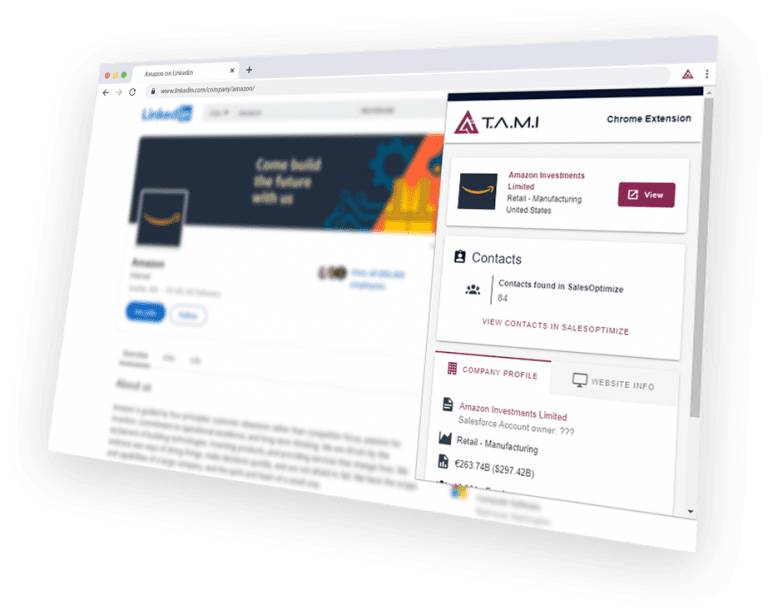
Pull verified contacts, tech stack, payment providers and merchant data from any company site or social profile while you're already looking at it. Export straight to your CRM.
- Website
- Facebook
- Twitter
Send us your segment definition and we'll tell you how many UK companies match it, and how many are showing activity this month.
Explore more solutions
Every solution runs on the same UK dataset. Pick the problem you're solving today.
Frequently asked
questions
Read a response before you write a line of code
Get a key, run a query for your own use case, and see exactly what comes back.