
A B2B intent data provider that reports what companies actually did
Most B2B intent data providers tell you an anonymous person at a company read something about your category last week. TAMI AI tells you the company switched payment provider, changed platform or started hiring commercial staff. One is a probability. The other happened.
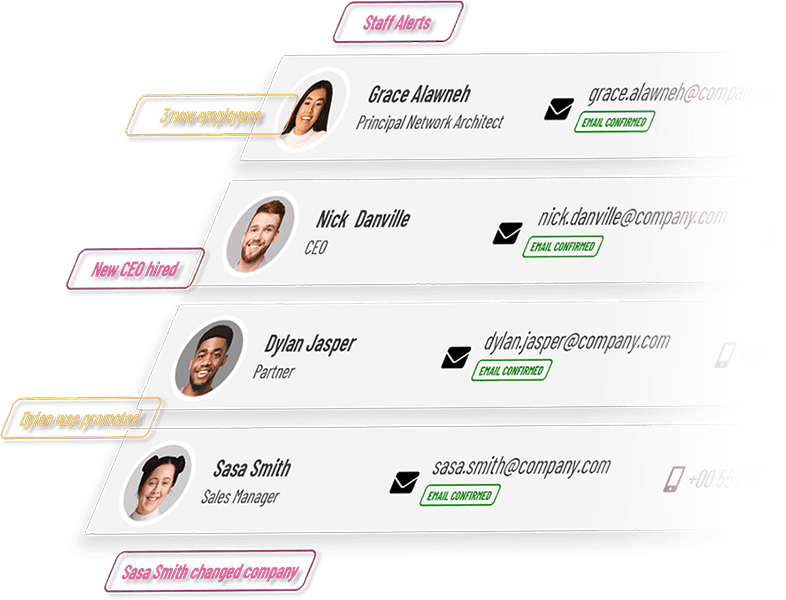
We re-read company websites continuously and detect the changes that matter: new vendors appearing, old ones disappearing, platform migrations, BNPL adoption, carrier switches. Each signal arrives attached to a company record and a verified contact.
71m company records. Signals read from live sites. Contacts attached.
No card needed. See which companies in your market changed something this month.
A surge score cannot be called. A vendor switch can.
Topic intent tells you interest exists somewhere inside an organisation, usually without naming who. An observed change tells you the decision is already in motion, and gives your rep something specific to open with.
What is B2B intent data?
B2B intent data is information suggesting a company is in the market for something. It comes in three broad forms. Third-party intent tracks content consumption across publisher networks and reports topic-level surges by company. Review-site intent reports category and product page activity. First-party intent identifies visitors to your own website.
All three infer interest from reading behaviour, usually at company level without naming the person. A fourth kind gets overlooked: observed intent, meaning changes a company has actually made. Adopting BNPL or migrating platform is action, and action beats attention.
Why intent data disappoints
Three failures, and the first is the one nobody warns you about.
The signal is anonymous
Topic surges tell you a company showed interest, not who. Your rep still has to guess which of forty people to contact, which is where most intent programmes quietly stall.
Interest is not a decision
Someone reading about a category may be a student, a competitor, or an analyst. Reading is cheap. Switching vendor costs money and takes approval.
The window has usually closedl
By the time a topic surge is reported, aggregated and scored, the shortlist may already exist. Observed changes surface at the moment the work is happening.
Observed beats inferred. TAMI AI reports what a company changed, when it changed, and who to speak to about it.
READING ABOUT IT AND DOING IT ARE NOT THE SAME SIGNAL
One is attention. The other is budget already moving.
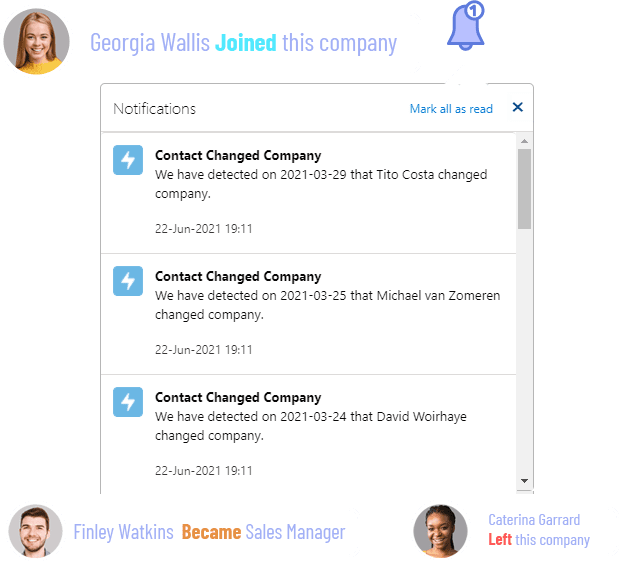
A new payment provider means the payments stack is under review. A platform migration means every adjacent vendor is in play. Those are not guesses about interest, they are consequences of decisions already taken.
See which companies in your market changed something this month. The count is free.
WHAT OUR CLIENTS THINK OF TAMI





Which buying signals matter in your market?
Six verticals our customers monitor, and the observed signal that opens the conversation.
-
Payments and fintech
A new processor or BNPL provider appearing on a merchant site.
Explore payments → -
eCommerce
Platform migrations, checkout changes and newly trading merchants.
Explore eCommerce → -
SaaS and tech
Martech and analytics tools installed or removed..
Explore SaaS → -
Logistics
Carrier switches and new destination corridors.
Explore logistics → -
Manufacturing
Trade portals, online ordering and ERP going live.
Explore manufacturing → -
Retail
New currencies, storefronts and loyalty systems appearing.
Explore retail →
Our European patent for merchant detection is what makes the payments, checkout and carrier signals possible, and none of them appear in a conventional intent feed.
Three questions no analyst report will answer
One
Is the signal an observed change or an inferred interest?
Two
Does it name a contact, or stop at company level?
Three
How long between the behaviour happening and the signal reaching me?
Not a score. A change you can name.
Every signal arrives with the company, the change, the date and the verified contacts inside that business.
What TAMI AI detects
Not topics or page views. Changes to the business itself.
Vendor added or removed
A new tool appearing beside an incumbent, or an old one disappearing.
Platform migration
A move between ecommerce platforms, when every adjacent vendor is reconsidered.
Payment provider change
New processors, methods or BNPL adoption on a merchant site.
Carrier and corridor change
A shift in who fulfils orders, or a new destination market appearing.
Commercial hiring
Sales and marketing roles being added, which usually precedes tooling budget.
Newly trading merchant
A business that has just started selling online, with no incumbent to displace.
Combine any of them.
Combine signals with firmographics and technology filters, then export the companies with contacts attached.
WE DON'T TRACK READERS. WE TRACK CHANGES
TAMI AI is not a topic-intent network and does not de-anonymise your website traffic. We re-read company websites continuously and report what changed, so a signal is a documented fact about a business rather than a probability derived from anonymous browsing. The same process keeps records current through our data enrichment API.

458M+
CONTACTS


REAL TIME
REFRESH


What comes back with every signal
We don't hand you a score and leave you to work out the rest. Six things arrive together.
- The change itself What was added, removed or replaced, named specifically.
- The date it appeared When the change was detected, so you can judge how open the window still is.
- The prior state What the company ran before, which is often the more useful half of the signal.
- The full company record Sector, size band, revenue band, region and the rest of the stack.
- Named decision-makers Verified emails and direct dials inside that business, not just a company name.
- A saved monitor Criteria you keep running, so the next change surfaces without you asking.
Is B2B intent data GDPR compliant?
It depends on the type. Signals built from tracking individual browsing raise real questions about lawful basis and transparency. TAMI AI reads publicly published company websites rather than monitoring people, so detection involves no personal data. Attached contact records carry documented lawful basis and managed suppression.
How TAMI AI compares to other B2B intent data providers
Two platforms UK teams evaluate alongside us, and what each does best.
| Bombora | G2 Buyer Intent | TAMI AI | |
|---|---|---|---|
| Signal type | Topic consumption | Category and product research | Observed change |
| Basis | Inferred interest | Inferred interest | Documented action |
| Named contacts included | No | Limited | Yes |
| Prior state before the change | No | No | Yes |
| Payments and carrier signals | No | No | Patented |
| Coverage limited to a network | Publisher co-op | G2 users and categories | Any company with a website |
| Personal browsing data involved | Yes, consented | Yes, consented | None |
| Delivery to your own systems | Data feed | Integrations | API |
| Free tier | No | No | Yes |
How to use B2B intent data properly, in six steps
Decide what each signal means commercially
Installed, removed or replaced are three different plays. Read the change before you decide the approach.
Prefer action over attention
Reading is cheap. A vendor change cost money and needed approval, which is why TAMI AI reports changes rather than topic scores.
Check the prior state
What a company switched from often tells you more than what it switched to, and the previous vendor comes with the signal.
Move inside the window
Signals decay within weeks. Continuous detection means you hear about a change while it is happening, not at the next list review.
Get to a named person
A company-level signal still needs a contact. Every TAMI AI signal arrives with verified decision-makers inside that business.
Keep the monitor running
Saved criteria surface the next change automatically, so nobody has to remember to re-run the query.
Intent data answers whether a company might buy. Observed change answers whether it has already started. Only one of those can be diarised.
WHAT TEAMS DO WITH IT
 Catch migrations while vendors are being chosen
- Open with the change rather than a pitch
- Prioritise accounts that moved this month
- See what a prospect switched away from
- Reach the decision-maker, not the domain
- Trigger campaigns on observed change
- Suppress accounts that just bought elsewhere
- Score accounts on action rather than attention
- Feed signals into your own model by API
- Monitor a segment continuously, not quarterly
Attention is cheap and anonymous. Action is documented and named. Work the second one
TAKE THE SIGNALS INTO YOUR OWN SYSTEMS
Some teams want signals in the platform. Others want them inside a scoring model or a product.
- The data enrichment API delivers company, technology, payments, carrier and contact fields, and keeps enriching them as sites change.
- Stripe, United States Postal Service, Trustpilot and DHL use TAMI AI to see what companies are doing.
NO CUSTOM DEVS. JUST PLUG IN
With TAMI AI, building a verified UK contact list takes minutes. Setup is instant. Data starts flowing straight away. Here's what TAMI AI integrates with:





QUALIFY A COMPANY WITHOUT LEAVING THE TAB
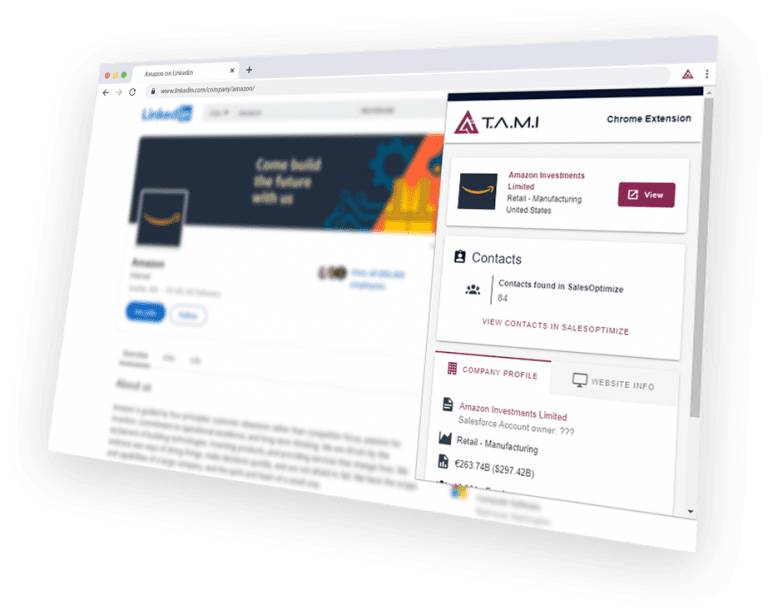
Pull verified contacts, tech stack, payment providers and merchant data from any company site or social profile while you're already looking at it. Export straight to your CRM.
- Website
- Facebook
- Twitter
Send us your segment definition and we'll tell you how many UK companies match it, and how many are showing activity this month.
Explore more solutions
Every solution runs on the same UK dataset. Pick the problem you're solving today.
Frequently asked
questions
Stop scoring interest. Start tracking decisions.
See which companies in your market changed vendor, platform or provider this quarter, and who to speak to inside them.