
Lookalike company targeting that matches on what a business does
Most lookalike company targeting returns the same sector, the same size band, the same city. TAMI AI matches on what a business actually runs, sells and ships, which is why the results include companies your sector filter would never have returned.
Upload your best accounts and we compare them across technology stack, payment providers, shipping carriers, trading status, size and region, then return every company that matches, ranked by how closely.
71m company records to match against. Ranked by attribute overlap.
No card needed. Upload ten accounts and see what comes back.
Same sector is not the same business.
Two UK retailers of the same size can run different platforms, different processors, different fulfilment and sell to different buyers. One is a lookalike of your best customer. The other just shares a classification code.
What is lookalike company targeting?
Lookalike company targeting means finding businesses that resemble a set you already know works, usually your best customers or a competitor's install base. You supply the seed list, the model identifies what those companies share, and it returns others matching that pattern.
Everything depends on which attributes the model can see. A system holding only sector, size and location will return companies that match on paperwork. A system that reads platform, payment provider, carrier and trading behaviour returns companies that match on how they operate, which is what actually predicted the original wins.
Why lookalike lists come back wrong
Three failures, and the first is almost universal.
It matched on category
Sector code, headcount band and geography are the default attributes because they are the easiest to hold. They describe a company's shape, not its operation.
The seed list was too narrow
Ten accounts from one vertical produce a model that only finds that vertical. The pattern reflects where you sold first rather than where the product fits.
Nothing explained the match
A ranked list with no reasoning cannot be corrected. If you cannot see which attributes drove the score, you cannot tell a good match from a coincidence.
Match on operation, not classification. TAMI AI compares technology, payments, carriers and trading behaviour, then shows which attributes drove each result.
SIMILARITY IS ONLY AS GOOD AS WHAT YOU CAN SEE
A model cannot match on an attribute it does not hold.
That widens what similarity can mean. Your best accounts might share a checkout provider, a fulfilment corridor or a platform rather than an industry, and only a model holding those fields can find the rest of them.
Upload ten of your best accounts and see which attributes they share. The count is free.
WHAT OUR CLIENTS THINK OF TAMI AI





What similarity means in your market
Six verticals our customers model in, and the attribute that separates a real lookalike from a category match.
-
Payments and fintech
Processor, payment methods and BNPL adoption rather than sector.
Explore payments → -
eCommerce
Platform, checkout stack and verified trading status.
Explore eCommerce → -
SaaS and tech
The tools a company runs, including the ones you integrate with.
Explore SaaS → -
Logistics
Carrier relationships and the corridors actually served.
Explore logistics → -
Manufacturing
Digital maturity, from trade portals through to ERP.
Explore manufacturing → -
Retail
Currencies accepted, storefront count and international footprint.
Explore retail →
Our European patent for merchant detection is what puts payment and fulfilment attributes into the matching model. On one UK martech engagement, lookalike targeting built this way produced a conversion rate far above the lists the team had been buying.
Three questions to ask about any lookalike model
One
Which attributes did you match on, and can I see them?
Two
Can the model match on how a company operates, or only on how it is classified?
Three
How many of the returned companies were already in my CRM?
Not a black box. A ranked list you can interrogate.
Every match comes back with the attributes that drove it, the company record behind it, and verified contacts inside it.
What TAMI AI matches on
Sector and size are the floor. These are what make a lookalike worth working.
Technology stack
Platform, CMS, martech, analytics and hosting, read from the live site.
Payments and checkout
Processor, payment methods, currencies and BNPL adoption.
Fulfilment and carriers
Who ships their orders and into which destination markets.
Trading status
Whether a company genuinely trades online, so dormant sites stay out.
Firmographics
Region, city, headcount band and revenue band across four UK nations.
Growth signals
Hiring and expansion activity, so similarity reflects direction as well as state.
Combine any of them.
Weight the attributes that mattered in your wins and ignore the ones that did not.
WE MATCH ON OPERATION, NOT ON CLASSIFICATION
Most similarity models inherit an industry code and compare shapes. TAMI AI reads live websites and classifies what each business actually does, so a match reflects operation rather than registration. The same reading keeps every attribute current, and the fields are available through our data enrichment API.

458M+
CONTACTS


REAL TIME
REFRESH


What comes back from a lookalike search
We don't hand you a ranked list and leave you guessing. Six things arrive together.
- The ranked matches Every company that fits, ordered by attribute overlap rather than alphabetically.
- The shared attributes Which signals drove each match, so you can judge whether the logic holds.
- The full company record Sector, size, region, stack, payments and trading status per match.
- Named decision-makers Verified emails and direct dials inside the matching businesses.
- CRM deduplication Existing accounts and open opportunities removed before export.
- A saved seed set Criteria you rerun as your customer base grows and the pattern sharpens.
Where does TAMI's matching data come from?
From the open web, read directly. We don't resell databases or licence third-party feeds. Every attribute used in matching is read from the live company website and classified with AI. All UK and EU data carries documented lawful basis and managed suppression.
How TAMI AI compares on finding similar companies
Two platforms UK teams evaluate alongside us, and what each does best.
| Ocean.io | Clay | TAMI AI | |
|---|---|---|---|
| Purpose-built for lookalikes | Yes | Configurable | Yes |
| Matching on payments and BNPL | No | Depends on sources | Patented |
| Matching on carriers and corridors | No | Depends on sources | Yes |
| Verified trading status | No | Depends on sources | Yes |
| Attributes behind each match visible | Partial | Yes, if you built it | Yes |
| Contacts included in one dataset | Yes | Via waterfall | Yes |
| Requires assembling other providers | No | Yes | No |
| Delivery to your own systems | Integrations | Integrations | API |
| Free tier | Trial | Free plan | Yes |
How to build a lookalike list properly, in six steps
Pick the right seed set
Use accounts that closed fast, stayed and expanded. Revenue alone includes the deals that were painful to win and unlikely to repeat.
Spread the seeds across verticals
Ten accounts from one sector produce a model that only finds that sector. Mix them, even if the sample gets smaller.
Look at what they share before you expand
The shared attributes are the model. TAMI returns them ranked, so you can read the pattern and discard anything that looks accidental.
Weight the attributes that mattered
A shared processor may predict fit better than a shared sector. Weight accordingly rather than treating every overlap as equal evidence.
Strip out what you already have
Deduplicate against your CRM on import, so the list contains genuinely new companies rather than accounts your reps are already working.
Rerun as the base grows
Every new win sharpens the pattern. Save the seed set and a model built on thirty accounts becomes a better one at sixty.
A lookalike model is only as good as the attributes behind it. Anything matching on sector and size is describing a shape, not a similar business.
WHAT TEAMS DO WITH IT
 Turn thirty good accounts into a working list
- Prioritise matches by attribute overlap
- See why each company was returned
- Skip the accounts already in pipeline
- Reach decision-makers inside every match
- Expand a converting segment into a bigger audience
- Match on stack rather than sector
- Size a lookalike segment before spending against it
- Feed matches into campaign targeting
- Refresh the model as new customers close
Your next hundred customers probably look like your last ten. See who they are.
LOOKALIKES OF THEIR CUSTOMERS, NOT JUST YOURS
A seed list does not have to be your own accounts.
- Point the model at a competitor's customer base and it returns companies resembling the businesses already buying in your category, which is a wider pool than your own wins alone.
- Stripe, United States Postal Service, Trustpilot and DHL use TAMI AI to find more companies like their best ones.
NO CUSTOM DEVS. JUST PLUG IN
With TAMI AI, building a verified UK contact list takes minutes. Setup is instant. Data starts flowing straight away. Here's what TAMI AI integrates with:





QUALIFY A COMPANY WITHOUT LEAVING THE TAB
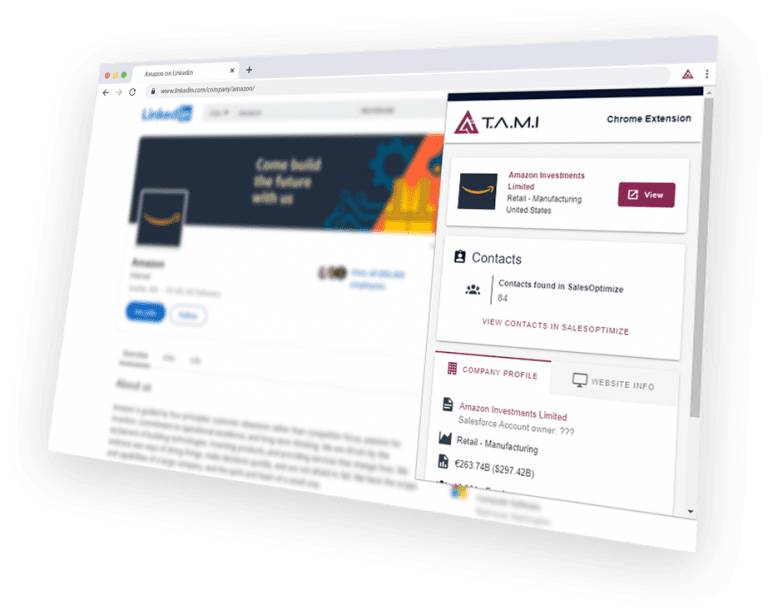
Pull verified contacts, tech stack, payment providers and merchant data from any company site or social profile while you're already looking at it. Export straight to your CRM.
- Website
- Facebook
- Twitter
Send us ten of your best accounts and we'll tell you how many UK companies genuinely resemble them, and why.
Explore more solutions
Every solution runs on the same UK dataset. Pick the problem you're solving today.
Frequently asked
questions
Stop matching on sector codes
Upload your best accounts and see which UK companies genuinely resemble them, and why.