
Energy company data for the subsectors nobody wrote a code for
We hold energy company data covering the businesses that built themselves after the classifications were set: solar and battery installers, EV charging operators, heat pump firms, connection providers and energy brokers, each described by what they actually do.
TAMI AI reads what a company publishes about itself, so a battery storage developer is identified as a battery storage developer rather than as general electrical contracting. Every record carries the subsector, the region, the size band and the commercial contacts.
1.6m UK companies. 36m verified contacts. Classified by what they publish.
No card needed. Name a subsector and see how many UK firms describe themselves that way.
There is no SIC code for battery storage.
Nor for EV charging operation, nor for heat pump installation as a trade. Those industries arrived after the codes were written, so filtering a company register for them returns either nothing or everything.
What is energy company data?
Energy company data identifies the businesses operating across generation, supply, networks and the trades that build and maintain all of it, along with the people inside them who buy. It is used by anyone selling software, plant, components, engineering services, consultancy or staffing into the sector.
Energy is two markets wearing one label. The licensed core is small and well documented, and anyone in the sector can name it. The edge is thousands of installers, developers, operators and brokers that arrived after the classifications were set, so they sit nowhere coherent in any of them. Useful energy company data finds the second group.
Where a register stops and a website starts
Three groups the classification system handles badly.
Trades that are new
Heat pumps, battery storage, EV charging. Each gets filed under whichever code came closest, usually electrical or construction, which tells you nothing.
Firms that do several things
A solar company that also fits batteries and chargers has one code and three businesses. The code picks one, arbitrarily, and often not the one you sell to.
Firms that moved
Plenty of renewables businesses started somewhere else entirely, in roofing, in electrical contracting, in plumbing, and the registration never followed them.
TAMI AI reads the description a company gives of itself, so subsector, specialism and service mix come from what a firm says it does rather than what it filed when it incorporated.
WE IDENTIFY THE COMPANIES. WE DO NOT HOLD THE ENERGY DATA
Two very different things share a name, and it is worth separating them before anyone gets the wrong idea.
TAMI AI holds no meter points, no generation output, no wholesale prices and no consumption figures. It identifies businesses, describes what they do and supplies the contacts.
Market analysts handle the commodity side and nothing here replaces that. What they will not give you is every UK firm calling itself a battery storage developer, with an engineering director attached.
Name a subsector and see how many UK firms describe themselves that way. Free.
WHAT OUR CLIENTS THINK OF TAMI AI





Six ways suppliers to the sector use TAMI AI
There are six ways teams selling into energy and utilities use TAMI AI.
-
Market Segmentation
Separate solar, storage, EV, heat pump and network trades into distinct segments.
Segment your market → -
B2B Lead Generation
Build lists by subsector, region, size and accreditation signals, with contacts attached.
Find your buyers → -
B2B Market Intelligence
Size a subsector before committing a product line or a sales hire to it.
Size your market → -
B2B Intent Data
Spot firms hiring, expanding or adding a new service line.
Catch buying signals → -
Sales Territory Planning
Build patches around where installers and contractors actually cluster.
Plan your patches → -
B2B Contact Database
Reach directors, engineering leads and operations managers directly.
Search contacts →
One set of records behind all six, so a subsector count and a contact export describe the same firms.
What a company register cannot tell you
Three answers the classification system cannot give you.
What it actually installs
The code says electrical contracting. The site says ground source heat pumps and commercial solar.
How much of its work is yours
Occasional battery jobs alongside domestic rewiring is a different prospect from a dedicated storage developer.
Whether it is growing into your product
Service lines get added fast here. This year's specialism may not have existed last year.
Three answers, all published on the firm's own site
Every record carries the subsector, the specialisms described, the size band and the people to speak to.
What a firm's own description gives you
Six things worth filtering on, none of which appear in a classification code.
Subsector and specialism
Solar, storage, EV charging, heat pumps, wind, networks, water, brokerage and consultancy.
Service mix
Where a firm describes several activities, so multi-trade businesses are identifiable as such.
Accreditation and scheme signals
Certifications and memberships published on the site, where a firm displays them.
Region and coverage area
Location to city level, plus the areas a firm says it serves.
Size and growth indicators
Headcount band and hiring activity, which move fast in this sector.
Still active
Confirmed against a live web presence, which matters where new entrants are frequent.
Narrow as far as you need. A single filter set returns the trading firms in one region describing commercial battery installation.
THE CODES CAME BEFORE THE INDUSTRY
Every classification system freezes at the moment it is written. The trades doing most of the growth in UK energy were not industries when the current codes were set, so they were absorbed into whatever existed. TAMI AI classifies from the description a company publishes today, which is the only source that has kept up with how quickly this sector reorganises.

458M+
CONTACTS


REAL TIME
REFRESH


What comes back against each firm
Six fields per business, built from what the company says about itself.
- The subsector identified What the firm describes itself as doing, rather than the code it was filed under.
- Specialisms and service lines Including secondary activities where a firm lists more than one.
- Accreditations displayed Scheme memberships and certifications where they appear on the site.
- Region and stated coverage Where the firm is based and the areas it says it works across.
- Named contacts Directors, engineering and operations leads, with a checked email and a direct number.
- CRM delivery Deduplicated on import, so firms you already supply do not reappear as prospects.
Does this include domestic or consumer energy data?
No. Nothing here touches households, meter points, tariffs or consumption, which keeps it outside consumer energy regulation entirely. The only personal data involved is business contact records, held under UK GDPR with a lawful basis on file and suppression we manage. PECR's email rule excludes corporate subscribers, though many installers and contractors are sole traders and count as individuals.
Where TAMI AI sits next to the sources this sector already uses
Two platforms UK teams evaluate alongside us, and what each does best.
| Cornwall Insight | Certification registers | TAMI AI | |
|---|---|---|---|
| Market and price analysis | Extensive | No | No |
| Policy and regulatory coverage | Extensive | No | No |
| Scheme accreditation status | No | Authoritative | Where published |
| Subsector by self-description | No | Scheme scope only | Yes |
| Multi-trade firms identified | No | No | Yes |
| Coverage beyond accredited firms | Partial | No | 1.6m UK companies |
| Verified contacts included | No | No | Yes |
| Email verification standard | Not applicable | Not applicable | Under 5% bounce |
| Refresh | Research cycle | Scheme updates | Continuous |
Mapping a subsector the register cannot see
Write down how the firms describe themselves
Not the industry term, the words on their websites. TAMI AI classifies from published description, so the vocabulary a trade uses about itself is what surfaces it.
Search the description, not the code
Set the subsector in TAMI AI and it returns firms whose own site says that is what they do, including ones filed under electrical, construction or plumbing.
Sort the specialists from the generalists
TAMI AI shows where a firm lists several activities, which separates a dedicated storage developer from a domestic electrician who occasionally fits batteries.
Add region before size
Installers and contractors work locally. Filter geography first in TAMI AI, since a national list in a regional trade is mostly noise.
Layer accreditation where it matters
Where firms display scheme membership, TAMI AI picks it up. It is a useful signal on quality, though the scheme's own register remains the definitive check.
Recount when the sector shifts
Subsectors here appear and consolidate quickly. Saved criteria in TAMI AI let you rerun the same map and see what has changed rather than rebuilding it.
In a sector this young the hard part is not finding contacts. It is agreeing what to call the companies you are looking for.
WHAT SUPPLIERS TO THE SECTOR DO WITH IT
 Find installers by subsector rather than by trade code
- Separate specialists from occasional operators
- Build regional patches around where contractors cluster
- Catch firms adding a new service line
- Reach engineering and operations leads directly
- Map brokers, consultancies and bureau providers
- Size a subsector before funding a product line
- Identify firms hiring into a new capability
- Exclude businesses that have stopped trading
- Push qualified firms into your CRM
Filtering a register for a trade that has no code returns nothing or everything. Neither is a list.
THE PARTS OF THIS MARKET THAT DID NOT EXIST BEFORE
Most of the movement in UK energy sits in trades that are newer than the systems used to categorise them.
- TAMI AI covers utilities sector leads UK teams struggle to source elsewhere: EV charging operators, battery storage developers, heat pump specialists, connection providers and the brokers serving them.
- Stripe, United States Postal Service, Trustpilot and DHL use TAMI AI to understand commercial markets.
Stripe, United States Postal Service, Trustpilot and DHL use TAMI AI to understand commercial markets.
NO CUSTOM DEVS. JUST PLUG IN
With TAMI, building a verified UK contact list takes minutes. Setup is instant. Data starts flowing straight away. Here's what TAMI integrates with:





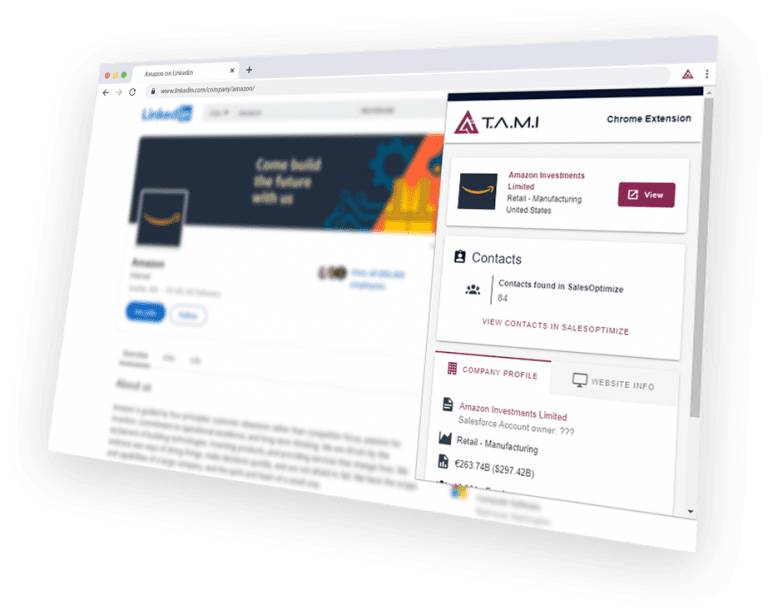
QUALIFY A COMPANY WITHOUT LEAVING THE TAB
Pull verified contacts, tech stack, payment providers and merchant data from any company site or social profile while you're already looking at it. Export straight to your CRM.
- Website
- Facebook
- Twitter
Give us a subsector and a region. We will come back with how many UK firms describe themselves that way, and who to ask for.
Explore more industries
Every industry runs on the same UK dataset. Pick the market you sell into.
Frequently asked
questions
Find the energy firms a classification code cannot describe
Search by what a business says it does, narrow by region and size, and take the contacts with you.