
Contact data management that starts with where the contact came from
Ask any provider how a specific email was verified and the answer gets vague. Contact data management is really provenance management: knowing the source of every record, how it was checked, and when. Everything else is storage.
TAMI AI verifies at inbox level rather than generating addresses from name patterns, and we don't resell third-party databases, so the origin of every record is traceable. 36 million verified B2B contact data, checked and re-checked as people move.
458m contacts worldwide. 36m in the UK. Under 5% bounce.
No card needed. Check a sample against your own ICP before you commit.
A guessed address and a verified one look identical.
Both are firstname.lastname@company.com. One was confirmed to exist, the other was assembled from a pattern and hoped for. Your sequencer cannot tell the difference. Your bounce rate finds out three days later.
What is contact data management?
Contact data management is how an organisation acquires, verifies, stores and maintains the contact records it uses to sell. It covers where records come from, how they're checked, how duplicates are resolved, who owns the fields, and when a record is retired.
Most teams treat it as storage. Records arrive, land in the CRM, and are assumed true until something breaks. Managed properly, verified B2B contact data carries its provenance with it: the source, the verification method and the date it was last confirmed. That's the difference between a database you can trust and one you can only hope about.
Why contact records fail
Three failures, and only one of them is visible before you send.
The address was guessed
Pattern tools invent firstname.lastname, then score their own guess. It behaves like a real record until it bounces. TAMI AI confirms the inbox exists first.
Provenance is missing
Resold databases pass records between vendors, and the source disappears in transit. When your DPO asks about lawful basis, "our supplier says it's fine" isn't an answer.
One person, four records
The same contact enters via a form, a purchase, a conference export and an integration. Without matching on import you get four partial records, all slightly different.
Know where every contact came from.
TAMI AI verifies at inbox level, sources directly, and matches on import so one person stays one record.
"VERIFIED" IS NOT A REGULATED WORD
Every provider uses claims to have verified B2B contact data. Almost none define it, and the definitions that exist are wildly different.
Some mean a pattern scored highly. Some mean a contributor typed it in. Some mean it was correct when the file was built. Ask which one you're buying.
Run a sample through and see what our verification catches. For free.
WHAT OUR CLIENTS THINK OF TAMI AI





What kind of verified B2B contact data does TAMI source?
The main verticals our customers build contact coverage in, and what sits alongside the contact record.
-
Payments and fintech
Decision-makers at merchants, with processor and BNPL context attached.
Explore payments → -
eCommerce
Contacts at genuine trading merchants, not dormant storefronts.
Explore eCommerce → -
SaaS and tech
Buyers at companies running the platforms you integrate with.
Explore SaaS → -
Logistics
Operations and commercial contacts, mapped to carriers and corridors.
Explore logistics → -
Manufacturing
Decision-makers at firms modernising systems and ordering online.
Explore manufacturing → -
Retail
Contacts at multi-site and cross-border operators, separated by footprint.
Explore retail →
Our European patent for merchant detection is what puts commercial context beside the contact, so a rep opens with what the business runs rather than a job title.
Three questions to ask any contact data provider
One
How was this specific email verified, and on what date?
Two
Did you source this record yourselves, or buy it from someone who did?
Three
What happens to a record when the person leaves the company?
Not a list. A record with a history.
Every contact in TAMI AI carries its verification and its source, so the answers are on the record rather than in a sales conversation.
What sits on a TAMI AI contact record
A name and an email is a lead. This is a record.
Inbox-verified email
Confirmed the address accepts mail, not generated from a naming pattern.
Direct dial
Straight through to the person rather than a switchboard.
Current role and seniority
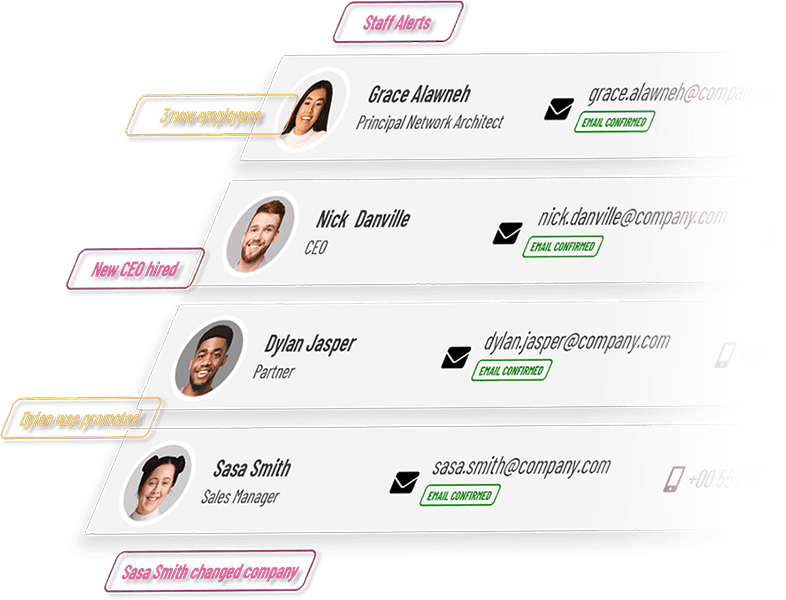
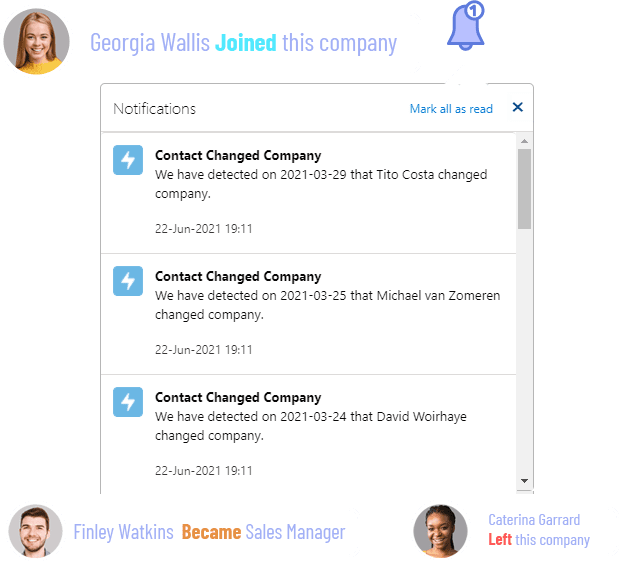
Re-checked continuously, with moves and promotions flagged.
Company context
Technology stack, payment providers and carriers alongside the person.
Location and firmographics
Region and city across England, Scotland, Wales and Northern Ireland.
Documented source
Where the record came from and when it was last confirmed.
Filter contacts by what their company runs.
Filter contacts by what their company runs, not just by job title. Heads of ecommerce at UK merchants using a specific checkout, for example.
WE DON'T RESELL ANYONE'S DATABASE
Most contact data changes hands several times before it reaches you, and provenance thins with every transfer. TAMI AI builds records directly, classifies companies from live websites and verifies contacts at inbox level, which means we can tell you where any record came from and when it was last confirmed.

458M+
CONTACTS


REAL TIME
REFRESH


What comes back when you build a contact list
Not a CSV of guesses. Six things, all traceable.
- Verified contacts Checked at inbox level before export, holding bounce under 5%.
- Coverage depth per account How many decision-makers we hold inside each target company.
- Seniority and function mapping Who does what, so the list matches the buying committee.
- Company signals attached What each business runs, ships and processes payments through.
- CRM-ready records Deduplicated on import to Salesforce, HubSpot, Pipedrive, Close and Mailchimp.
- Change alerts afterwards Job moves and departures flagged so records stay true.
Is buying B2B contact data legal in the UK?
Yes, when sourcing is documented. A work email is personal data under UK GDPR, so you need a lawful basis, source transparency and suppression. PECR's email rule excludes corporate subscribers, though some partnerships and sole traders count as individuals. TAMI AI sources directly, so provenance is traceable.
How TAMI AI compares on verified B2B contact data
Two platforms UK teams evaluate alongside us, and what each does best.
| Lusha | Hunter | TAMI AI | |
|---|---|---|---|
| How records are built | Contributor network and partners | Web indexing and pattern finding | Direct sourcing from live sites |
| Verification method | Community validation and AI | MX and SMTP checks | Inbox-level confirmation |
| Company context on the record | Firmographics | Minimal | Tech, payments, shipping, merchant status |
| UK coverage depth | Not published separately | Not published separately | 36m UK contacts |
| Resells third-party data | Partly, via vendors | No | No |
| Trading status of the company | No | No | Yes |
| Change alerts on job moves | Yes | No | Yes |
| Source documented per record | Contributor-dependent | Shows where found | Yes |
| Free tier to test | 40 credits monthly | 50 credits monthly | Yes |
How to run contact data management properly, in six steps
Ask how verification actually works
Make every provider define the word before you compare accuracy claims. With TAMI, an inbox has to accept mail before the record is allowed into the database at all.
Insist on provenance per record
A contact that changed hands three times carries no usable audit trail, and your DPO will ask. Sourcing directly rather than buying in is what keeps the origin attached.
Match before you write
One person should be one record, and that only holds if matching happens at the point of import. Our exports deduplicate against your CRM on the way in, not afterwards.
Decide who owns which field
Set rules on what a bulk update may overwrite. A rep who confirmed a mobile by phone last week beats any automated source, including ours, and no import should quietly replace it.
Retire records, don't just store them
People leave and companies close, but neither event announces itself in a CRM. Departures get flagged, and because trading status comes from the live site, dead companies surface too.
Re-verify on a cycle, not on discovery
Finding out through a bounced campaign is the expensive route, and by then the damage has reached your sending domain. Continuous re-checking is what keeps TAMI records confirmed between campaigns.
Every provider says verified. The word means nothing until someone tells you the method, the date and the source. Without those three, an accuracy percentage is just a number.
WHAT TEAMS DO WITH IT
 Source contacts without reselling in the chain
- Document provenance for compliance reviews
- Deduplicate on import across every source
- Retire departed contacts automatically
- Standardise fields across systems
- Reach decision-makers on the first attempt
- Open with what the company runs
- See coverage depth inside target accounts
- Get flagged when a contact moves
- Export straight into your sequencer
Guessed addresses cost you a domain reputation. Verified ones cost you a click. Find out which kind you are buying.
GLOBAL REACH, UK DEPTH
Most global databases hold impressive totals and thin UK coverage skewed towards enterprises with a US parent.
- TAMI AI holds 458 million contacts worldwide, including 268 million across North America and 108 million in the EU, with 36 million in the UK alone.
- Stripe, United States Postal Service, Trustpilot and DHL use TAMI AI to reach the right people.
NO CUSTOM DEVS. JUST PLUG IN
With TAMI AI, building a verified UK contact list takes minutes. Setup is instant. Data starts flowing straight away. Here's what TAMI AI integrates with:





QUALIFY A COMPANY WITHOUT LEAVING THE TAB
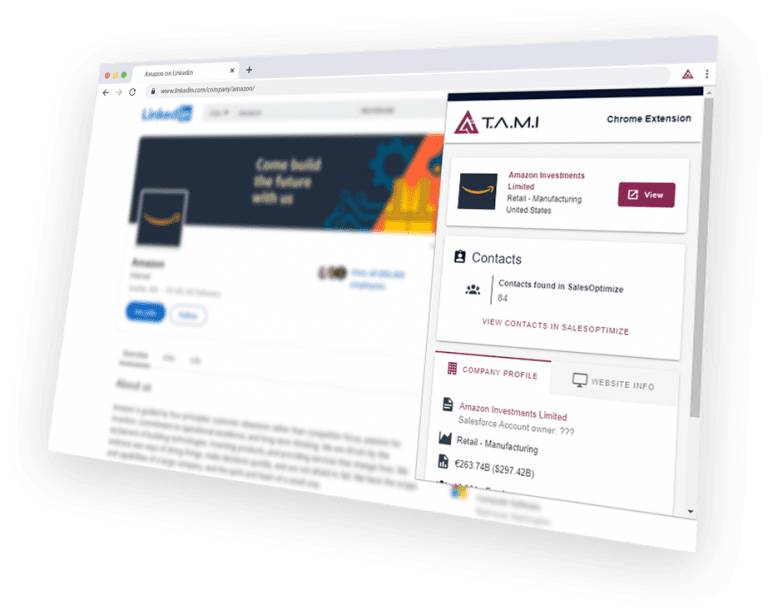
Pull verified contacts, tech stack, payment providers and merchant data from any company site or social profile while you're already looking at it. Export straight to your CRM.
- Website
- Facebook
- Twitter
Send us your segment definition and we'll tell you how many UK companies match it, and how many are showing activity this month.
Explore more solutions
Every solution runs on the same UK dataset. Pick the problem you're solving today.
Frequently asked
questions
Stop buying contacts you can't trace
See the verified B2B contact data inside your target accounts, and check where every record came from.